
Blog
Complete Guide
The Complete Guide to Digital Marketing Services for Small Businesses

Digital marketing is no longer optional for small businesses. Search, social, email, and paid advertising now determine whether a brand is found, trusted, and chosen — before a customer ever sets foot through the door.
Yet most small business owners face the same problem: too many channels, too little time, and no unified view of what is actually driving revenue. Fragmented tools, inconsistent execution, and unclear attribution eat budgets faster than they build growth.
This guide covers every major category of digital marketing services — what each one does, when to use it, how to evaluate providers, and what measurable outcomes to expect. Whether you are building your first strategy or consolidating a scattered setup, this is the map you need.
From search engine optimization in digital marketing to paid ads, content marketing services, and review management, every section stands alone so you can jump directly to the area most relevant to your business right now.
What Are Digital Marketing Services?
Digital marketing services are professionally managed activities that help businesses attract, convert, and retain customers through online channels — including search engines, paid advertising platforms, social media, email, and review networks. They range from one-off projects like website design to fully managed, ongoing programs covering SEO, paid ads, content creation, and reputation management. For small businesses, these services replace or augment in-house marketing capacity, translating online visibility directly into measurable revenue growth.
What Is Digital Marketing? The Foundation Every Business Needs
Digital marketing is the practice of reaching and influencing potential customers through internet-connected channels rather than traditional print, broadcast, or direct mail. It encompasses everything from how a business appears in Google search results to how it manages its reputation across review platforms and engages audiences on social media.
Understanding the four Ps of marketing — Product, Price, Place, and Promotion — remains the strategic foundation. Online channels have expanded what 'Place' and 'Promotion' mean. The 4Ps of marketing now play out across search engines, social feeds, email inboxes, and AI answer engines simultaneously.
For small businesses, digital marketing matters because the cost per customer acquired online is measurable in a way that billboard or radio advertising is not. Every click, form submission, and purchase can be tracked back to a specific channel, campaign, and keyword — giving owners the radical clarity needed to invest confidently.
- Search visibility: being found when buyers actively look for your product or service
- Paid reach: putting your message in front of high-intent audiences before they find a competitor
- Social presence: building brand familiarity and community across the platforms your customers use daily
- Email retention: staying top-of-mind with existing customers to increase lifetime value
- Reputation signals: review volume and quality that directly influence local purchase decisions
- AI citation: appearing in answers generated by ChatGPT, Perplexity, and Google AI Overviews
Seven Core Types of Digital Marketing Services Explained
The digital marketing landscape is wide, but most services fall into seven functional categories. Each one addresses a different stage of the customer journey — from initial awareness to post-purchase retention. Understanding each category helps small businesses prioritize spending and avoid duplicating effort.
SEO marketing services focus on earning organic search visibility over time. Paid advertising platforms capture in-market demand immediately. Social media marketing builds brand presence and community. Email marketing drives retention and repeat revenue. Content marketing services fuel every other channel. Review management protects and amplifies trust. Website optimization turns existing traffic into leads and customers.
These categories are interdependent. Strong content marketing improves SEO rankings and provides material for social and email campaigns. A well-optimized website increases the return on every dollar spent on paid ads. Treating them as isolated line items rather than a connected growth engine is one of the most costly mistakes small businesses make.
- SEO and local SEO: long-term organic traffic from search engines
- PPC and Google Ads management: immediate paid traffic from high-intent queries
- Social media marketing: brand awareness and community building across key platforms
- Email marketing: automated, personalized campaigns that increase customer LTV
- Content marketing services: blog posts, service pages, and guides that attract and convert
- Review and reputation management: monitoring, responding to, and generating customer reviews
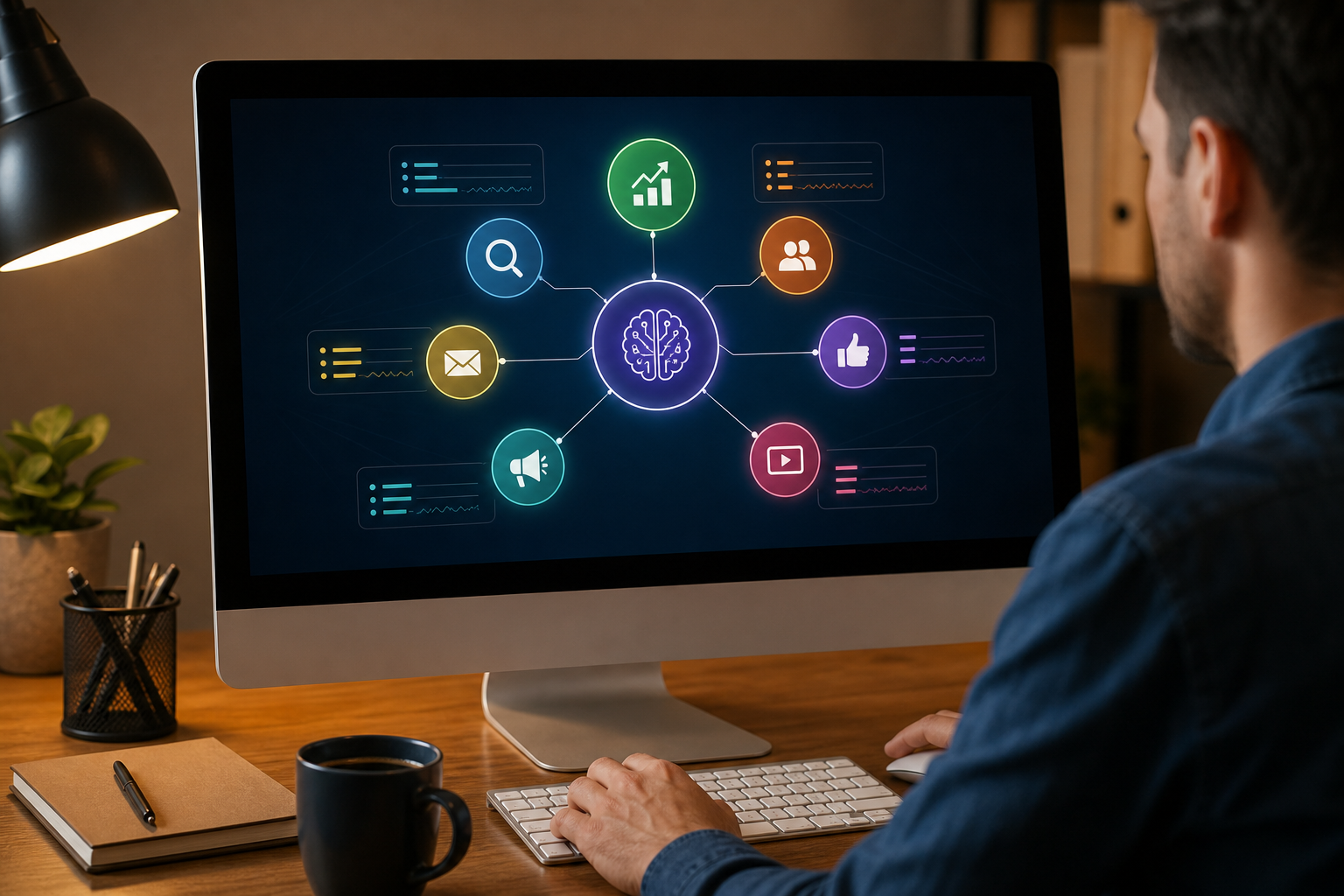
How SEO and Local SEO Drive Sustainable Organic Growth
Search engine optimization in digital marketing is the process of improving a website's visibility in organic (unpaid) search results. For small businesses, local SEO is the highest-priority subset — optimizing to appear in Google Maps, local pack results, and 'near me' queries that signal strong purchase intent.
Effective SEO covers three interconnected areas: technical health (page speed, Core Web Vitals, structured data), on-page optimization (title tags, header hierarchy, keyword placement aligned to buyer intent), and off-page authority (backlinks and Google Business Profile signals). Neglecting any one area limits the impact of work done in the other two.
Cube, backed by Sequoia Capital and built by Stanford GSB and IIT alumni, combines autonomous AI agents for keyword research, page audits, and content suggestions with human strategists who monitor algorithm changes in real time. Brands using this managed SEO approach typically see a 2x increase in organic website traffic within 90 days.
- Optimize Google Business Profile: accurate NAP data, categories, photos, and Q&A for every location
- Fix technical issues first: slow pages, broken links, and poor Core Web Vitals suppress all other SEO work
- Target buyer-intent keywords: match search terms to the funnel stage the page is designed to serve
- Build internal links: connect related service pages to distribute authority and guide user journeys
- Earn quality backlinks: local citations, industry directories, and editorial mentions outperform volume-based schemes
- Track rankings monthly: catch drops early and convert data into actionable priorities
Four Key Paid Advertising Channels for Small Business Growth
Paid advertising delivers immediate, measurable reach that organic SEO cannot replicate in the short term. For small businesses, four channels represent the majority of high-return opportunity: Google Search ads, Google local ads, Meta ads, and — for product-based businesses — Amazon sponsored listings.
The most common failure mode in paid ads is treating budget allocation as a set-and-forget task. Without real-time bid management, audience segmentation, and creative testing, campaigns bleed spend on low-intent clicks. Any online advertising platform or managed PPC service should be evaluated on its ability to optimize toward contribution margin, not just click volume.
A Google Ads manager or dedicated paid media team tracks metrics that connect ad spend to actual revenue: cost per acquisition, LTV:CAC ratio, and return on ad spend. These numbers require ongoing human judgment alongside automated bidding tools to get right.
- Google Search ads: capture high-intent demand from users actively searching for your service
- Google local ads: drive calls, directions, and bookings for location-based businesses
- Meta ads: retarget website visitors and build lookalike audiences from existing customers
- Bing and Amazon ads: lower-competition channels that often deliver stronger ROAS for specific business types
- Creative testing: systematically test headlines, images, and CTAs to continuously raise conversion rates
- Real-time budget reallocation: shift spend toward top-performing campaigns daily, not monthly
Content Marketing, Social Media, and Email: Three Channels That Compound
Content marketing services, social media marketing, and email marketing share a compounding dynamic: each piece of content created can be repurposed across all three channels, multiplying its value. A well-researched service page improves SEO, gets shared on a LinkedIn company page, and becomes the body of an email campaign — all from a single production effort.
Social media marketing is most effective when posting cadence is consistent, creative is tailored to platform norms, and performance data informs what gets produced next. Word of mouth marketing has always been the highest-trust channel; social media is its digital amplifier. An influencer marketing platform or influencer marketing agency extends this further by connecting brands with creators whose audiences match their ICP.
Email marketing remains one of the highest-ROI internet marketing services available. Subscribers grouped by behavior, purchase history, and lifecycle stage receive messages relevant to where they are in the buying journey. Automated A/B testing on subject lines and content ensures each campaign performs better than the last.
- Develop a content marketing strategy before producing any assets — map content types to funnel stages
- Post consistently on the social platforms your customers actually use, not every platform at once
- Segment email lists by behavior and lifecycle stage to increase open rates and conversion
- Repurpose long-form content into social posts, email snippets, and short-form video
- Track engagement metrics that indicate purchase intent, not just vanity metrics like follower count
- Use competitor tracking to identify content gaps your audience is searching for elsewhere
Review Management and Reputation: Why They Drive Local Revenue
Online reviews are now a primary ranking signal in local search and a decisive factor in consumer trust. A business with a high volume of recent, positive reviews on Google, Yelp, and industry-specific platforms consistently outperforms competitors in both search visibility and conversion rate — regardless of other marketing investment.
Reputation management goes beyond responding to reviews. A structured system proactively prompts satisfied customers to leave feedback, escalates negative experiences privately before they become public one-star reviews, and monitors sentiment trends across every platform from a single dashboard. At scale, across multiple locations or dozens of listings, this requires automation to execute consistently.
Responding to every review with brand-aligned, specific language also serves an SEO function: keyword-rich responses on Google Business Profile listings contribute to local search relevance. This intersection of reputation management and SEO is often overlooked by small businesses managing reviews manually.
- Monitor reviews across Google, Yelp, TripAdvisor, and any industry-specific platform relevant to your vertical
- Respond to every review — positive and negative — within 48 hours to signal active management
- Proactively prompt satisfied customers at the right moment in the service journey to increase review volume
- Escalate negative feedback privately before the customer posts publicly, where possible
- Analyze sentiment trends across locations to identify operational issues marketing alone cannot fix
- Use keyword-relevant language in review responses to support local SEO signals
How to Choose Between a Digital Marketing Agency, Platform, or Managed Service
Small businesses typically evaluate three delivery models: a traditional digital marketing agency, a self-serve online marketing platform, or a hybrid managed service that combines both. Each has a distinct risk and capability profile.
A traditional digital marketing company offers human strategy and execution but often involves long ramp times, opaque reporting, and account manager turnover. A self-serve online marketing platform for small businesses gives you control and lower cost but requires internal time and expertise to operate. A managed service operates as a growth engine: autonomous AI agents handle execution at scale while dedicated human strategists set direction and tune performance in real time.
The right choice depends on three variables: the size of your internal marketing team, the number of channels you need to run simultaneously, and how much accountability you need built into the relationship. Businesses with no internal marketing capacity and multi-location complexity typically get the strongest results from a fully managed model.
- Evaluate a digital marketing agency on attribution clarity, reporting cadence, and average client tenure
- Assess a self-serve platform on how much time your team can realistically dedicate each week
- For multi-location businesses, prioritize providers with centralized dashboards and location-level reporting
- Ask any prospective digital marketing specialist how they handle real-time algorithm changes
- Check for relevant certifications, investor backing, or verifiable case study data before committing
- Require that any platform or agency reports on CAC and ROAS, not just traffic and impressions
AI in Marketing: What It Automates and Where Humans Still Lead
AI in marketing has moved well beyond keyword research tools and basic scheduling. Modern autonomous AI agents can execute keyword audits, generate on-brand content, manage bid adjustments, respond to reviews, and segment email audiences simultaneously — tasks that previously required multiple specialists working in parallel.
Generative Engine Optimization (GEO) represents the newest frontier: ensuring your brand is cited and recommended by AI answer engines including ChatGPT, Perplexity, and Google AI Overviews. As more consumers start research conversations with AI rather than search engines, AI citation presence becomes a direct business development channel.
The boundary of AI's current value is strategic judgment. AI agents excel at execution speed, pattern recognition, and data processing at scale. Human strategists remain essential for setting campaign direction, interpreting ambiguous performance signals, and course-correcting when market conditions shift. The most effective model pairs both: AI as the execution layer, humans as the strategy layer.
- AI automates: keyword research, bid management, content drafting, review responses, and post scheduling
- Humans lead: strategy direction, creative judgment, brand positioning, and performance interpretation
- GEO builds AI citation presence across ChatGPT, Perplexity, Google AI Overviews, and Copilot
- Structured data and entity authority are the technical foundations of AI search visibility
- Monitor competitor AI citations to identify content gaps before they become ranking gaps
- Avoid platforms that use AI as a black box — demand transparency into what the system optimizes for
| Delivery Model | Best For | Human Oversight | Typical Setup Time | Reporting Clarity |
|---|---|---|---|---|
| Traditional Digital Marketing Agency | Businesses that want full-service execution with dedicated account management | High, but varies by agency size and account tier | 4–8 weeks onboarding | Often manual, monthly reports |
| Self-Serve Online Marketing Platform | In-house teams with marketing expertise and available bandwidth | Low — operator dependent | 1–2 weeks | Real-time dashboards, but interpretation is DIY |
| Hybrid Managed Service (e.g. Cube) | Multi-location businesses needing AI speed and human strategy without building an internal team | High — dedicated human strategists plus AI agents | 1–2 weeks with continuous real-time optimization | Unified dashboard with channel-level and location-level attribution |
| Freelance Digital Marketing Specialist | Businesses with a narrow, single-channel need and a defined scope | Moderate — dependent on individual | Variable | Inconsistent — no standardized reporting |
| In-House Marketing Team | Larger SMBs with resources to recruit, train, and retain marketing staff | Full control | 3–6 months to hire and ramp | Fully customizable but resource-intensive to build |
Frequently Asked Questions
-
What are digital marketing services for small businesses?
Digital marketing services for small businesses include SEO, paid advertising, social media management, email marketing, content creation, review management, and website optimization. These services help small businesses attract customers online, build brand trust, and convert traffic into revenue. They can be delivered by a digital marketing agency, a managed platform, or a combination of both depending on team size and budget. -
What is the difference between SEO marketing services and paid ads?
SEO marketing services build organic search visibility over time by improving a site's technical health, content, and authority — results compound but take months to materialize. Paid ads deliver immediate traffic by bidding on search terms or targeting audiences on social platforms. Most small businesses benefit from running both: paid ads for short-term demand capture, SEO for sustainable long-term growth and lower customer acquisition costs. -
What are the 4 Ps of marketing?
The four Ps of marketing are Product, Price, Place, and Promotion. Originally a framework for physical goods, the 4Ps of marketing now apply directly to digital strategy: Place means which online channels and platforms you appear on, and Promotion covers every digital tactic from search ads to content marketing. Understanding this framework helps small businesses align channel selection with overall business objectives rather than chasing tactics in isolation. -
How does AI in marketing help small businesses?
AI in marketing automates time-intensive tasks including keyword research, bid management, email segmentation, content drafting, and review responses — enabling small businesses to execute across multiple channels without large teams. The most effective AI marketing systems pair automation with human strategist oversight to ensure quality and strategic alignment. AI accelerates execution; humans set direction and interpret performance signals that require contextual judgment. -
What should I look for in a digital marketing agency?
Evaluate a digital marketing agency on attribution transparency, reporting frequency, and how they measure success — look for CAC, ROAS, and organic traffic growth rather than vanity metrics. Ask how they handle real-time algorithm changes and what their average client tenure is. Verify any claims with case studies or third-party data. A strong digital marketing company will tie every service directly to measurable business outcomes, not activity volume. -
What is local SEO and why does it matter for small businesses?
Local SEO is the practice of optimizing a business's online presence to appear in geographically relevant search results, including Google Maps, local pack listings, and 'near me' queries. For small businesses, local SEO directly influences foot traffic, phone calls, and bookings from high-intent nearby customers. Key elements include Google Business Profile optimization, accurate NAP data across directories, and localized on-page content targeting buyer-intent keywords. -
What is Generative Engine Optimization (GEO)?
Generative Engine Optimization is the practice of structuring and positioning content so that AI answer engines like ChatGPT, Perplexity, and Google AI Overviews cite your brand in their responses. As more consumers use AI platforms to research purchases, appearing in AI-generated answers is becoming a direct source of brand visibility and inbound leads. GEO involves structured content optimization, entity authority building, and ongoing monitoring of brand citations across AI platforms. -
How much do digital marketing services typically cost for a small business?
Digital marketing service costs vary widely based on channel complexity, provider model, and geographic market. A freelance digital marketing specialist may charge $500–$2,000 per month for a single channel, while a full-service digital marketing agency typically ranges from $2,500–$10,000 per month for multi-channel management. Managed hybrid platforms that combine AI execution with human strategy often deliver more channels at comparable cost by reducing manual labor overhead.