
Blog
Complete Guide
The Complete Guide to Social Media Marketing in 2026

Social media marketing is one of the most searched topics in digital marketing — and one of the most misunderstood. Brands pour budget into posts and ads without a coherent strategy, then wonder why engagement stays flat and revenue stays stuck.
Done right, social media marketing is a direct driver of customer acquisition, brand recall, and local visibility. Done wrong, it is an expensive content treadmill with no measurable ROI.
This guide covers everything: what social media marketing actually is, which platforms matter for which goals, how to build a strategy that compounds over time, what tools and metrics to track, and where most brands go wrong.
Whether you manage marketing for a single location or a multi-location brand across several cities, this guide gives you the map you need before you go deep on any one channel.
What Is Social Media Marketing?
Social media marketing is the practice of using social platforms — including Instagram, Facebook, LinkedIn, and others — to promote a brand, engage audiences, and drive business outcomes such as traffic, leads, and sales. It combines organic content, paid social ads, community management, and performance analytics into a coordinated strategy. Effective social media marketing connects platform activity directly to measurable revenue impact, not just follower counts or impressions.
What Is Social Media Marketing? The Foundation Every Strategy Needs
Social media marketing sits at the intersection of brand building and direct response. At its core, it means using social platforms to reach the right people, earn their attention, and move them toward a commercial outcome — a visit, a purchase, a booking, or an inquiry.
The discipline spans organic posts, paid social ads, influencer partnerships, community engagement, and performance analytics. These are not separate tactics; they are layers of the same strategy. A brand that runs social media ads without an organic presence loses trust. A brand that posts organically without paid amplification limits reach.
What separates effective social media marketing from mere content publishing is intent. Every post, every campaign, and every budget decision should map to a specific business goal — awareness, consideration, conversion, or retention. Without that mapping, social media becomes a cost center rather than a growth engine.
- Organic social: unpaid posts, stories, and reels designed to build audience and trust over time
- Paid social ads: targeted campaigns on platforms like Facebook, Instagram, and LinkedIn that reach users outside your existing audience
- Community management: responding to comments, DMs, and mentions to build relationships and brand loyalty
- Influencer marketing: partnering with creators who have established audiences relevant to your brand
- Analytics and reporting: tracking engagement, reach, conversions, and ROI to guide every future decision
- Content strategy: a documented plan that governs what you post, when, and why
Six Social Media Platform Categories and When to Use Each
Not every platform deserves equal investment. The right mix depends on your audience, your industry, and your conversion goals. Spreading budget thin across every network is one of the most common and costly mistakes brands make.
Social platforms generally fall into distinct categories based on how people use them. Understanding those social media categories helps you allocate time and budget where they will compound — not evaporate.
For multi-location businesses in hospitality, healthcare, food and beverage, and home services, Instagram and Facebook consistently deliver the strongest local reach and conversion rates. LinkedIn becomes essential when the buying decision involves a professional or a committee. TikTok and YouTube serve awareness and brand recall at the top of the funnel.
- Visual discovery platforms (Instagram, Pinterest): best for product showcases, lifestyle content, and local brand awareness
- Professional networks (LinkedIn): strongest for B2B lead generation, employer branding, and thought leadership
- Short-form video platforms (TikTok, YouTube Shorts): high reach for awareness campaigns, particularly with under-40 audiences
- Community platforms (Facebook Groups, Reddit): effective for loyalty building, local community engagement, and peer recommendations
- Long-form video (YouTube): ideal for tutorials, product demos, and content that educates buyers before purchase
- Messaging-first platforms (WhatsApp, Messenger): growing channel for direct customer service and re-engagement campaigns
How to Build a Social Media Marketing Strategy in Five Steps
A social media strategy is a documented plan that connects platform activity to business outcomes. Without one, posting is reactive, budgets are wasted, and performance is impossible to improve. With one, every decision has a rationale and every result has a benchmark.
The five-step framework below applies whether you manage one location or fifty. The inputs change; the structure does not.
The most important step is the first one: defining the goal before choosing the platform or format. Brands that reverse this order — picking Instagram because a competitor is there, or running ads because a vendor pitched them — almost always underperform.
- Step 1 — Set measurable goals: define what success looks like in numbers (leads per month, cost per acquisition, engagement rate)
- Step 2 — Identify your audience: build platform-specific audience profiles based on demographics, behavior, and buying intent signals
- Step 3 — Choose platforms deliberately: invest in two or three channels where your audience is active, not every channel that exists
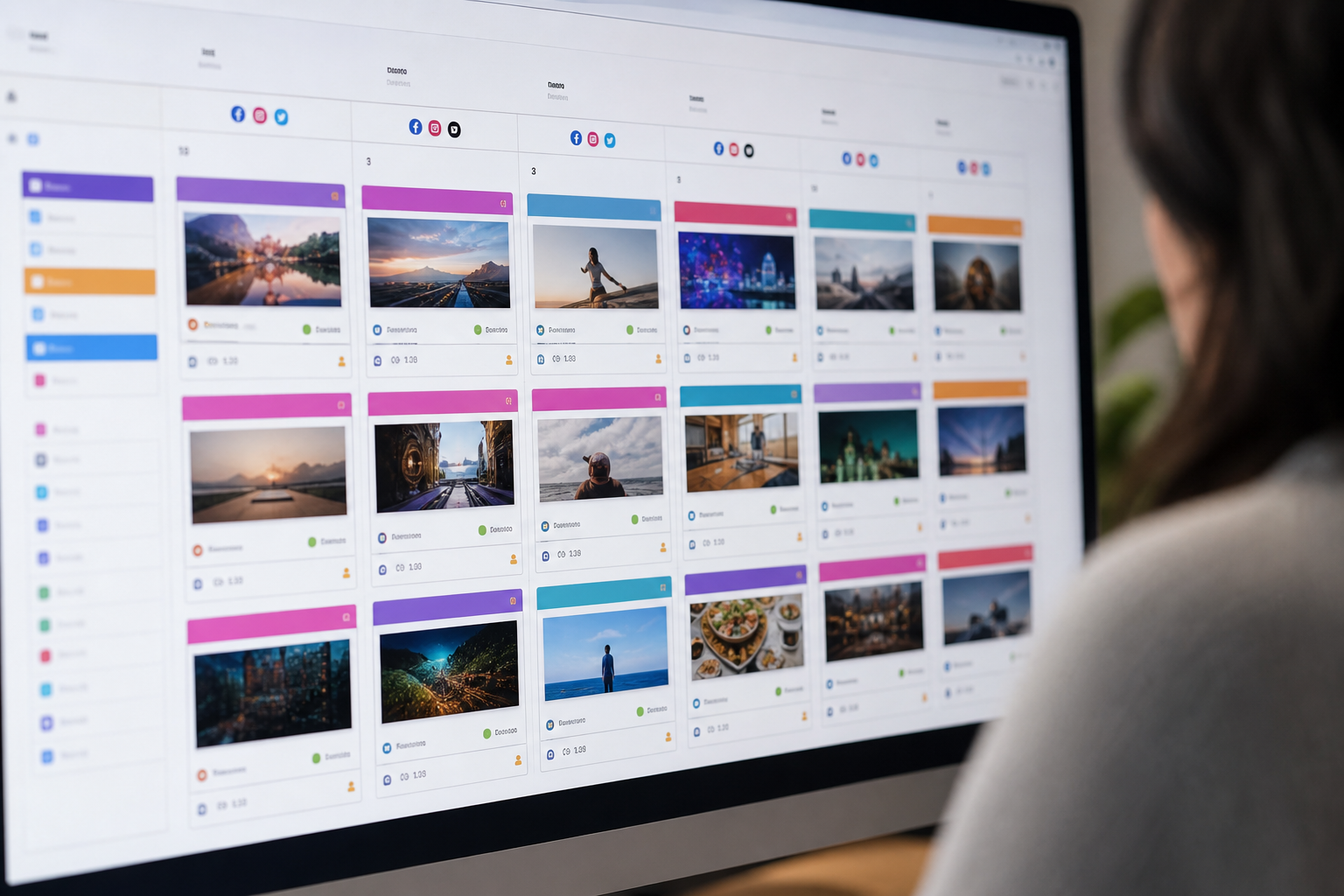
- Step 4 — Build a content calendar: plan post types, formats, and publishing cadences at least four weeks in advance
- Step 5 — Measure, report, and iterate: track performance weekly and adjust strategy monthly based on data, not instinct
Four Core Social Media Marketing Services and What Each Delivers
Social media marketing services range from content creation and scheduling to full campaign management and influencer coordination. Understanding what each service delivers helps you evaluate providers, allocate budget, and set realistic expectations.
Most brands need a combination of services, not a single offering. A restaurant group, for example, benefits from consistent organic posting, localized social media ads, and proactive community management simultaneously. Running only one of these in isolation produces diminishing returns.
When evaluating a social media marketing agency or managed service, the key question is not what they offer — it is what they measure. Any provider that reports only on reach and impressions rather than leads, conversions, and revenue impact is optimizing for the wrong outcomes.
- Content creation and scheduling: producing platform-native posts, captions, and creative assets, then publishing at optimal times
- Social media ads management: building, targeting, and optimizing paid campaigns on Facebook, Instagram, LinkedIn, and other platforms
- Influencer marketing: identifying, briefing, and managing creator partnerships that reach relevant audiences authentically
- Community management: monitoring mentions, responding to comments and DMs, and escalating issues before they damage brand reputation
- Analytics and reporting: translating platform data into revenue-connected insights that drive strategy adjustments
Three Common Social Media Marketing Mistakes That Kill ROI
Most social media programs underperform not because of budget size but because of avoidable strategic errors. The three mistakes below account for the majority of wasted spend and stalled growth across industries.
The first mistake is treating all platforms identically. Posting the same content in the same format across Instagram, LinkedIn, and Facebook ignores how audiences behave on each. Instagram rewards visual storytelling. LinkedIn rewards professional insight. Facebook rewards community and local relevance. One-size-fits-all content underperforms everywhere.
The second mistake is measuring vanity metrics. Follower count and impressions are easy to report but hard to connect to revenue. Brands that optimize for likes often find their conversion rates unchanged. The metrics that matter are click-through rate, cost per lead, and revenue attributed to social channels.
The third mistake is inconsistency. Posting heavily for two weeks, going quiet for a month, then resuming with a different visual style destroys audience trust and algorithmic momentum. Consistency in cadence, voice, and creative quality is the single most underrated driver of long-term social media performance.
- Platform mismatch: using the same content format and tone across platforms with different audience expectations
- Vanity metric optimization: reporting on reach and followers rather than leads, conversions, and revenue
- Inconsistent posting cadence: irregular publishing schedules that break algorithmic momentum and audience trust
- No paid amplification: relying entirely on organic reach in an era where most platforms limit unpaid distribution
- Ignoring community management: posting without responding to comments or messages signals low brand investment to both audiences and algorithms
AI Digital Marketing and the Future of Social Media Management
Artificial intelligence has changed what is operationally possible in social media marketing. Tasks that once required hours of manual effort — keyword research, caption writing, hashtag selection, optimal publish time analysis — can now be executed in minutes by purpose-built AI agents.
The most effective implementations pair AI automation with human strategic oversight. AI handles the high-volume, repeatable execution layer: content drafts, scheduling, performance alerts, and competitor monitoring. Human strategists handle the judgment-intensive layer: campaign direction, brand voice calibration, audience positioning, and budget prioritization.
Cube, founded by Stanford GSB and IIT alumni and backed by Sequoia Capital, runs exactly this model. Its AI-Human Harmony system manages social media across Instagram, Facebook, LinkedIn, and other platforms simultaneously, with human strategists reviewing performance and adjusting direction in real time. For multi-location brands in healthcare, hospitality, and food and beverage, this architecture eliminates the inconsistency that typically plagues distributed marketing operations.
The direction of travel is clear. By 2026, brands that integrate AI execution with human strategy will outpace those relying on either purely manual agency models or fully automated software tools that leave strategy decisions to the user.
- AI content generation: autonomous agents draft platform-native captions, post ideas, and hashtag sets aligned to brand voice
- Predictive scheduling: machine learning models identify optimal publish times by platform, audience segment, and content type
- Real-time performance monitoring: automated alerts surface underperforming posts and budget inefficiencies before they compound
- Competitor intelligence: continuous tracking of competitor posting activity, ad spend signals, and engagement benchmarks
- Human strategy oversight: expert review of AI outputs ensures brand alignment, creative quality, and strategic coherence
How to Choose a Social Media Marketing Agency: Five Questions to Ask
The market for social media marketing agencies is crowded. Most will show you case studies, quote engagement rate improvements, and offer a monthly retainer. Very few will show you a clear line from social activity to revenue impact.
Choosing the right agency or managed service requires asking the right questions before signing anything. The five questions below cut through positioning and reveal whether a provider is built for measurable outcomes or just content production.
Pay particular attention to how a provider talks about measurement. If the first metrics they mention are followers and impressions, that tells you where their optimization priorities sit. The best providers lead with leads, cost per acquisition, and contribution to revenue.
- What metrics do you report on, and how do they connect to revenue? — look for providers who lead with conversion and CAC data, not just reach
- How do you handle multi-location or multi-account management? — essential for franchise groups and regional brands
- What is your process when a campaign underperforms? — reveals whether real-time optimization is built into the model or treated as an exception
- How do AI tools and human experts interact in your workflow? — distinguishes managed growth systems from DIY software dressed as services
- Can you show attribution from a social campaign to a closed sale or booked appointment? — separates performance-focused providers from those optimizing for vanity metrics
| Approach | Who It's For | AI Automation | Human Oversight | Best Metric to Track |
|---|---|---|---|---|
| In-house social media team | Large brands with dedicated headcount | Varies by tools adopted | High — direct control | Engagement rate + revenue attribution |
| Traditional social media agency | Brands wanting full outsourced execution | Low to moderate | Moderate — account manager layer | Campaign reach + lead volume |
| DIY social media management platform | Small businesses with limited budget | Moderate — scheduling and drafts | Low — user-directed | Follower growth + post engagement |
| AI-Human managed service (e.g. Cube) | Multi-location and growth-focused brands | High — autonomous agents across channels | High — dedicated human strategists | CAC, ROAS, and contribution margin |
| Influencer marketing agency | Brands prioritizing awareness and creator reach | Low | Moderate — campaign management | Earned reach + brand sentiment |
Frequently Asked Questions
-
What is social media marketing and how does it work?
Social media marketing is the use of platforms like Instagram, Facebook, and LinkedIn to promote a brand, engage audiences, and drive business outcomes such as leads, sales, and bookings. It works by combining organic content, paid social ads, community management, and performance analytics into a coordinated strategy. Each element reinforces the others: organic content builds trust, paid ads extend reach, and analytics improve both over time. -
Which social media platforms are best for business marketing?
The best social media platforms depend on your audience and goals. Instagram and Facebook deliver strong results for B2C brands in retail, hospitality, and food and beverage. LinkedIn outperforms for B2B and professional services. TikTok and YouTube drive awareness with younger demographics. Most multi-location brands benefit from a primary focus on two or three platforms rather than spreading budget across all of them equally. -
What does a social media marketing agency do?
A social media marketing agency manages the strategy, content creation, publishing, paid advertising, community management, and performance reporting for a brand's social media presence. The best agencies connect social activity directly to revenue metrics like cost per lead and customer acquisition cost. Managed services that combine AI automation with human strategist oversight typically deliver faster optimization and more consistent results than traditional agency models. -
How do I build a social media marketing strategy?
Start by defining a measurable business goal — leads, bookings, or revenue — before choosing any platform or format. Then identify where your target audience is most active, build a content calendar at least four weeks in advance, and set a paid amplification budget. Review performance weekly and adjust monthly. A documented social media strategy consistently outperforms ad hoc posting in both engagement and conversion metrics. -
What are the best social media management tools?
The best social media management tools centralize scheduling, publishing, inbox management, and analytics across multiple platforms. Leading options include tools with AI content suggestion, multi-account management, approval workflows, and competitor tracking. For multi-location brands, prioritize platforms that offer location-level performance dashboards and support team-based approval workflows to maintain brand consistency at scale. -
What is the difference between organic social media and paid social ads?
Organic social media refers to unpaid content — posts, stories, and reels — that reaches your existing followers and their networks through platform algorithms. Paid social ads are targeted campaigns that reach users outside your audience based on demographics, interests, and behavior signals. Most effective social media strategies use both: organic content builds long-term trust while paid ads drive immediate reach and conversion at a controlled cost per acquisition. -
How do I measure the ROI of social media marketing?
Measuring social media ROI requires connecting platform activity to business outcomes. Track click-through rate, cost per lead, cost per acquisition, and revenue attributed to social campaigns via UTM parameters and conversion tracking. Avoid optimizing for reach or follower count alone — these metrics do not reliably correlate with revenue. Monthly reporting that maps social spend to closed sales or booked appointments is the clearest measure of real ROI. -
How does AI improve social media marketing performance?
AI improves social media marketing by automating high-volume tasks: drafting captions, selecting hashtags, scheduling posts at optimal times, and flagging underperforming content in real time. When paired with human strategists who set direction and calibrate brand voice, AI execution delivers faster iteration and greater consistency than manual workflows. Brands using AI-assisted social media management report up to 60% reductions in content production time without sacrificing quality.
Social Media Management Tools: What They Do and How to Evaluate Them
Social media management platforms centralize the tasks that would otherwise require five separate logins and three spreadsheets. They handle scheduling, publishing, inbox management, analytics, and in some cases content generation — all from a single interface.
The market for social media management tools has grown significantly as AI content capabilities have matured. Modern platforms can now draft captions, suggest hashtags, recommend posting times, and flag underperforming content automatically. For multi-location brands, these capabilities are not optional — they are the difference between a consistent presence and an inconsistent one.
Evaluating tools requires clarity on your actual workflow. A solo marketer and a regional team of ten have different needs. Prioritize tools that offer multi-account management, approval workflows, and performance dashboards that connect social activity to business metrics.