
Blog
Complete Guide
The Complete Guide to Website and SEO Services

Your website is not just a digital brochure. It is the top of your revenue funnel, and every page that fails to rank or convert is real money left on the table.
Search engine optimization in digital marketing has evolved well beyond keyword stuffing. Today it encompasses technical architecture, content authority, local visibility, and increasingly, how AI answer engines like ChatGPT and Google AI Overviews decide which brands to cite.
This guide covers every dimension of website and SEO services: what they are, how the core components work, what questions to ask before hiring a provider, and the common mistakes that quietly stall growth. Whether you are creating a website for a business from scratch or auditing an existing one, this is the map.
The goal here is breadth with precision. Each section stands alone, so you can read in any order and walk away with a clear, actionable picture of what modern web and SEO execution actually looks like.
What Are Website and SEO Services?
Website and SEO services are the combined set of professional disciplines that build, maintain, and optimize a business's web presence for both human visitors and search engines. They span web design and development, technical SEO, on-page content optimization, local SEO, and conversion rate optimization. Together, they ensure a site earns organic visibility, loads fast, and converts the traffic it attracts into measurable business outcomes.
What Is Website and SEO Services? The Foundation Every Business Needs
Website and SEO services are not two separate purchases. A website without SEO is an invisible storefront. SEO without a well-structured website is a strategy with nowhere to land. The two disciplines are co-dependent, and the most effective providers manage them together.
At the foundational level, web design services shape how a site looks, loads, and guides users toward a decision. Web development services handle the underlying code, hosting environment, and integrations that determine speed, security, and scalability. SEO then ensures the architecture and content of that site match what real buyers are searching for.
Understanding this interdependence is the first step to evaluating any provider. Ask whether they optimize for search intent during the build phase or treat SEO as an afterthought after launch. The answer will tell you a great deal about how they work.
- Web design services: visual layout, UX, mobile responsiveness, and brand consistency
- Web development services: code quality, CMS selection, page speed, and third-party integrations
- On-page SEO: title tags, meta descriptions, header hierarchy, and keyword placement
- Technical SEO: crawlability, site structure, structured data, and Core Web Vitals
- Local SEO service: Google Business Profile, NAP consistency, and location-based content
- Conversion optimization: forms, calls-to-action, and user journey design
Five Core Components of a High-Performing Website
Creating a website for a business involves more than choosing a template. Five structural components determine whether a site earns traffic, holds attention, and drives action. Each one can be measured and improved independently, but all five must work together for compounding results.
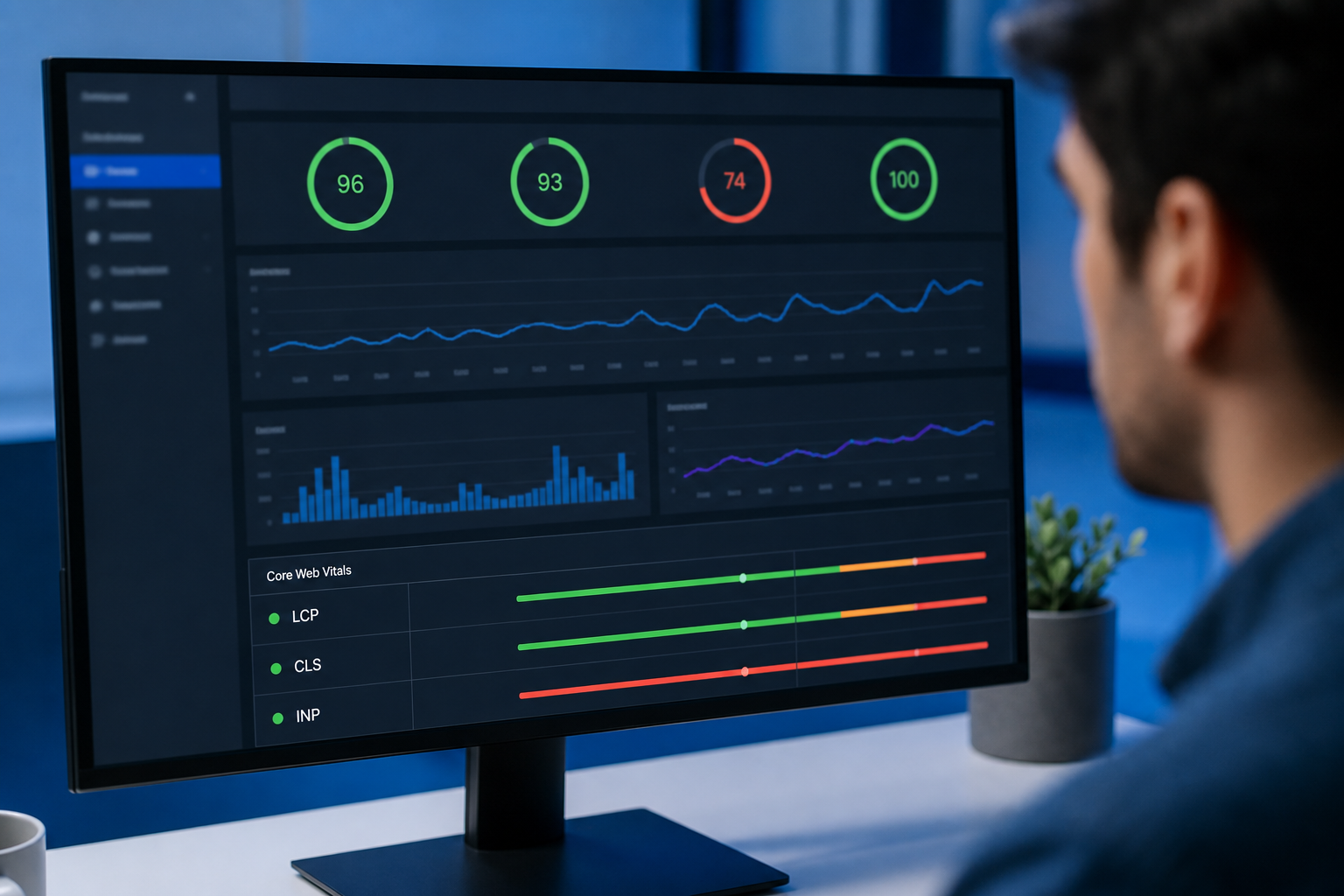
Page speed and Core Web Vitals sit at the top of the technical list. Google's ranking algorithm uses Largest Contentful Paint (LCP), Cumulative Layout Shift (CLS), and Interaction to Next Paint (INP) as direct ranking signals. A site that fails these thresholds loses rankings before a single visitor reads a word.
Mobile responsiveness is equally critical. More than 60% of web traffic now comes from mobile devices. A responsive design is not a feature; it is a baseline requirement for any credible web design services engagement.
- Page speed and Core Web Vitals (LCP, CLS, INP) for ranking eligibility
- Mobile-first responsive design for the majority of real-world traffic
- Clear site architecture and internal linking so search engines index every page
- Structured data markup to improve rich result eligibility and AI citation likelihood
- Conversion-focused landing pages aligned to specific buyer intent at each funnel stage
Four Types of SEO Services and When to Use Each
SEO is not one service. It is a family of distinct disciplines, each solving a different visibility problem. Knowing which type you need prevents wasted spend and misaligned expectations.
Technical SEO addresses the signals search engines use to crawl and index a site. It includes fixing broken links, improving site speed, implementing structured data, and ensuring Google can render JavaScript-heavy pages correctly. Google Webmaster Tools (now Google Search Console) is the primary diagnostic platform for this work.
On-page SEO optimizes the visible content of each page: the title tag, meta description, header structure, keyword placement, and internal linking. It is the discipline most directly connected to organic click-through rate and the one most frequently neglected after the initial site build. Local SEO service focuses on proximity-based queries and is the highest-leverage channel for any multi-location or service-area business.
- Technical SEO: site architecture, crawlability, page speed, and structured data fixes
- On-page SEO: title tags, headers, meta descriptions, and keyword-to-intent alignment
- Local SEO: Google Business Profile optimization, local citations, and location pages
- Off-page SEO: backlink acquisition, brand mentions, and domain authority building
Local SEO Service: The Highest-Leverage Channel for Multi-Location Brands
Local SEO service is the practice of optimizing a business's online presence to appear in location-specific search results, particularly the Google Maps pack and localized organic listings. For multi-location businesses in healthcare, hospitality, food and beverage, and home services, local SEO is not a nice-to-have. It is the primary acquisition channel.
The backbone of local SEO is Google Business Profile (GBP) optimization. Accurate name, address, and phone number (NAP) data, correct category selection, high-quality photos, and active Q&A content all influence whether a location surfaces in the top three map results. Managing this at scale across 10, 50, or 200 locations requires a systematic approach, not manual spot-checks.
Share of Local Voice (SoLV) is the metric that matters: how often your brand appears in local search results compared to competitors across all relevant queries in a given area. Brands that track SoLV have a real-time competitive signal rather than a lagging indicator. Cube's SEO service includes automated GBP management and SoLV tracking across all locations, and brands typically see a 2x increase in website traffic within 90 days of engagement.
- Optimize Google Business Profile for every location: NAP, categories, photos, Q&A
- Build location-specific service pages targeting buyer-intent keywords by city or region
- Maintain consistent citations across directories that influence local authority
- Track Share of Local Voice (SoLV) to measure competitive position in real time
- Use review volume and sentiment as local ranking signals, not just reputation metrics
- Align local content to the specific services offered at each location, not generic copy
Website Design Services vs. DIY Website Builders: Three Critical Differences
When creating a website for a business, the first fork in the road is build-it-yourself versus a managed web design services engagement. Platforms like WordPress website builder, Hostinger website builder, Square website builder, and Google website builder all lower the barrier to entry significantly. For a sole proprietor or early-stage startup, a DIY approach is often the right starting point.
However, three structural limitations emerge as businesses scale. First, DIY platforms optimize for ease of use, not for search engine performance. Default templates often generate poor title tag structures, unoptimized image files, and thin page content that underperforms against sites built with SEO baked in from day one. Second, multi-location businesses need consistent brand execution across dozens of pages. Maintaining that manually introduces errors, inconsistent messaging, and brand drift. Third, conversion optimization requires ongoing experimentation. DIY tools rarely include built-in A/B testing for forms, CTAs, or landing page layouts.
A professional website development company brings technical depth that compounds over time: structured data implementation, Core Web Vitals optimization, CMS architecture suited to scale, and integration with analytics and CRM systems. The ROI gap between DIY and managed web development widens as traffic and location count grow.
- SEO architecture: professional builds can include structured data, canonical tags, and schema from day one
- Brand consistency: managed services enforce design standards across every location page
- Conversion rate optimization: ongoing CRO testing requires tooling and expertise beyond standard builders
- Page speed: custom-built or professionally configured sites consistently outperform default templates on Core Web Vitals
How to Evaluate a Website and SEO Services Provider: Six Questions to Ask
The market for seo digital marketing and web development services is crowded. Providers range from freelancers and local web agencies to large-scale platforms with AI-assisted workflows. Asking the right six questions before signing a contract separates providers that deliver measurable ROI from those that report on activity without accountability.
Ask first: do they manage SEO and web design together, or as siloed services? The best outcomes come from providers who treat technical, on-page, and local SEO as an integrated system rather than separate line items. Ask second: what does their reporting look like? You should receive keyword ranking data, organic traffic trends, and conversion metrics in a single dashboard, not a 40-slide deck of screenshots.
Ask third: how do they handle Google algorithm updates in real time? A credible provider has a documented process for monitoring algorithm changes and deploying fixes before rankings drop. Ask fourth: can they demonstrate local SEO execution at scale? A local SEO consultant managing one client is very different from a system built to manage 50 locations simultaneously.
- Do they integrate web design and SEO from the build phase, not as an afterthought?
- What ranking, traffic, and conversion metrics do they report, and how often?
- How do they respond to Google algorithm updates, and what is their documented process?
- Can they manage local SEO across multiple locations from a centralized system?
- Do they use a website ranking checker and surface keyword opportunities proactively?
- Are human strategists reviewing and directing outputs, or is the service fully automated?
Generative Engine Optimization (GEO): The Next Frontier in Search Visibility
Search is no longer only Google's ten blue links. AI answer engines including ChatGPT, Perplexity, and Google AI Overviews now synthesize answers from multiple sources and present them directly to users, often without a click. For brands that want to capture this channel, traditional SEO is necessary but no longer sufficient.
Generative Engine Optimization (GEO) is the discipline of structuring content, building entity authority, and earning citations so that AI platforms select your brand as a source. It requires structured content that answers specific questions clearly, strong domain authority signals, and consistent brand mentions across credible third-party sources. AI search visibility optimization is increasingly a competitive differentiator: the brands that appear in AI-generated answers own top-of-funnel attention before a search query is even typed.
Cube's GEO service tracks brand citation presence across major AI platforms, identifies content gaps where competitors are being cited instead, and restructures service page content to meet the standards AI answer engines use when selecting sources. Brands typically see measurable AI citation presence within 90 days. This is the same hybrid model that drives Cube's SEO results: autonomous agents handle monitoring and content gap identification, while human strategists guide positioning and execution.
- AI answer engines select sources based on content structure, entity clarity, and authority signals
- Brand citation tracking across ChatGPT, Perplexity, and Google AI Overviews is a new baseline requirement
- Structured data implementation increases eligibility for AI-generated answers and rich results
- Service pages need to be rewritten for question-answer depth, not just keyword density
- GEO and traditional SEO are complementary, not competing, disciplines
- Brands with strong local SEO foundations gain a head start in AI citation eligibility
Three Common Mistakes That Stall Website and SEO Results
Most website and SEO service engagements that fail do not fail because of bad strategy. They fail because of three execution patterns that are predictable and avoidable.
Mistake one: treating the website launch as the finish line. A site goes live, the agency moves on, and no one is monitoring keyword rankings, fixing crawl errors, or optimizing underperforming pages. SEO is a continuous process. A website ranking checker should be running on a weekly cadence, with monthly reporting tied to organic traffic and conversion goals.
Mistake two: ignoring local SEO for multi-location businesses. Many brands invest in national SEO campaigns while their individual locations lose ground to local competitors in Google Maps. Each location needs its own optimized page, accurate GBP listing, and location-specific keyword targeting. Mistake three: disconnecting web design from conversion goals. Beautiful sites that do not convert traffic into leads are expensive vanity projects. Every design decision, from button placement to form length to page load time, should be tied to a measurable conversion outcome.
Portfolio website examples and landing page examples can inspire design decisions, but the benchmark should always be conversion rate and revenue impact, not aesthetic preference.
- Skipping post-launch SEO monitoring allows crawl errors and ranking drops to compound undetected
- Neglecting location-specific pages and GBP management costs multi-location brands significant local search share
- Separating web design decisions from conversion goals produces traffic without ROI
- Over-relying on DIY builders for scale-stage businesses creates technical debt that limits SEO performance
| Capability | DIY Website Builder | Freelance Web Designer | Traditional Digital Agency | Cube (AI + Human) |
|---|---|---|---|---|
| SEO Built Into Build Phase | Rarely | Sometimes | Often, but siloed | Yes, integrated from day one |
| Local SEO at Scale (Multi-Location) | No | No | Partial, manual | Yes, automated + human-verified |
| Core Web Vitals Optimization | Limited | Depends on developer | Yes, with extra scope | Yes, continuous monitoring |
| Real-Time Algorithm Response | No | No | Slow (weeks) | Yes, real-time AI monitoring |
| AI Answer Engine (GEO) Optimization | No | No | Emerging | Yes, dedicated GEO service |
| Unified Dashboard (SEO + Ads + Reviews) | No | No | No | Yes, all channels in one view |
| Human Strategist Oversight | No | Yes (limited) | Yes | Yes, dedicated strategist per account |
Frequently Asked Questions
-
What is the difference between web design services and SEO services?
Web design services focus on the visual layout, user experience, and technical structure of a website. SEO services focus on optimizing that site to rank in search engine results and attract organic traffic. The two are most effective when managed together: a site built without SEO in mind will require costly rework later. The best web design and SEO engagements treat them as a single, integrated system from the start. -
How do I choose a local SEO service for a multi-location business?
Look for a provider that can manage Google Business Profile optimization, location-specific landing pages, and citation consistency across every location from a centralized system. Ask how they track Share of Local Voice and whether they report ranking data by location. Providers that manage local SEO manually at scale tend to introduce errors. Automated systems with human oversight are the most reliable approach for businesses with more than five locations. -
How long does it take to see results from SEO services?
Most businesses see measurable keyword ranking improvements within 60 to 90 days of a properly executed SEO engagement. Traffic gains typically follow rankings by two to four weeks. Significant organic traffic growth, in the range of 50% to 2x, generally takes three to six months depending on domain authority, competition, and how aggressively technical and content issues are addressed. Ongoing optimization compounds results beyond that initial window. -
What should a website and SEO services provider report on each month?
A credible provider should deliver keyword ranking movement, organic traffic trends, Core Web Vitals status, and conversion metrics in a single, readable report. You should also see Google Business Profile performance for local businesses and any technical issues flagged by the website ranking checker. If a report only shows activity, such as pages published or links built, without connecting those actions to traffic and revenue, that is a gap to address immediately. -
What is Generative Engine Optimization (GEO) and why does it matter?
Generative Engine Optimization is the practice of structuring content and building brand authority so that AI answer engines like ChatGPT, Perplexity, and Google AI Overviews cite your brand in their responses. As AI-generated answers capture a growing share of search intent, appearing in those answers is a new form of top-of-funnel visibility. Brands that ignore GEO risk losing share to competitors who are already optimizing for AI citation. -
How much does professional website design in Canada cost?
Professional website design services in Canada typically range from $3,000 to $25,000 for a full build, depending on the number of pages, level of custom development, and whether SEO setup is included. Ongoing web management and optimization services are usually priced separately on a monthly retainer. For multi-location businesses, costs scale with location count and the complexity of integrating local SEO into each location page. -
What is the role of structured data in website and SEO services?
Structured data is code markup, typically using Schema.org vocabulary, that helps search engines and AI platforms understand the content and context of each page. It improves eligibility for rich results in Google search and increases the likelihood that AI answer engines select your content as a citation source. Implementing and maintaining structured data is a foundational technical SEO task that directly supports both traditional search rankings and GEO visibility. -
Can I build a website that ranks without hiring an SEO expert?
It is possible to build a functional website using platforms like WordPress website builder or other site builders, but ranking competitively without SEO expertise is difficult. Default templates often generate poor title tag structures and unoptimized page architecture. For low-competition niches, a well-configured DIY build may perform adequately. For any business targeting competitive keywords or multiple locations, professional SEO services applied from the build phase produce significantly better outcomes.