
Blog
Complete Guide
The Complete Guide to Review Management for Multi-Location Brands
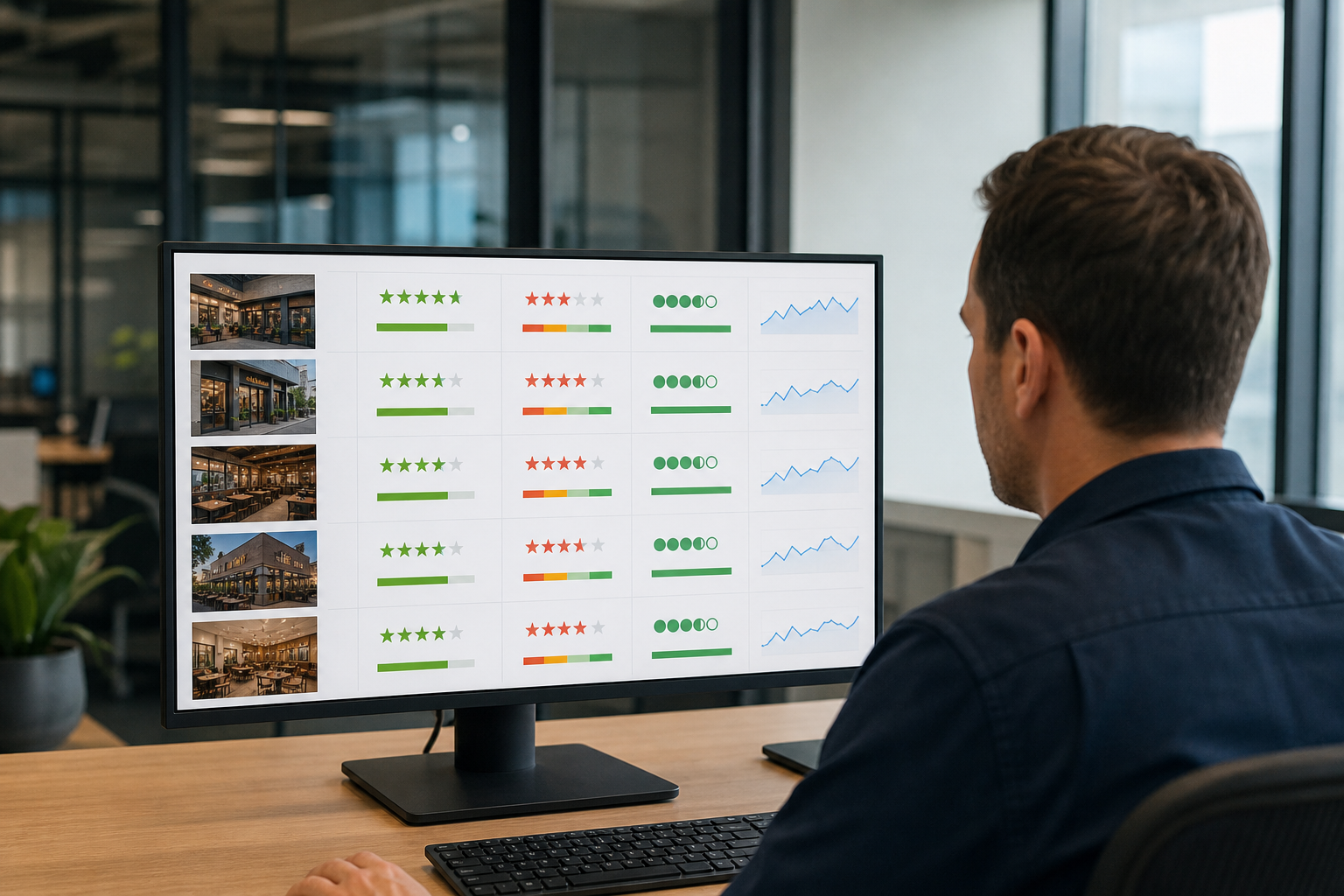
Every time a potential customer searches for your business, your reviews are the first thing they read. A single unanswered negative review or a thin star rating can redirect that customer to a competitor before they ever reach your website.
Review management is the disciplined practice of monitoring, responding to, and actively growing your online reviews across every platform where customers leave feedback. For multi-location brands in hospitality, healthcare, food and beverage, and home services, this is not a nice-to-have. It is an operational requirement.
This guide covers everything you need to get started: what review management actually is, why it matters for local search visibility, the tools and processes involved, and the common mistakes that leave brands exposed. Whether you are building a review management process from scratch or looking to scale what you already have, this is the map.
What Is Review Management?
Review management is the structured process of monitoring customer reviews across online platforms, responding to feedback in a timely and brand-consistent way, and proactively encouraging satisfied customers to share their experiences. It spans platforms like Google, Yelp, TripAdvisor, Airbnb, Expedia, and Booking.com. For businesses with multiple locations, effective review management requires a centralized system that surfaces sentiment trends, automates responses, and escalates critical issues before they damage the brand publicly.
Why Review Management Directly Impacts Revenue and Local Search
Online reviews are not just social proof. They are a measurable input into local search rankings, customer acquisition rates, and brand trust. Google's local ranking algorithm explicitly factors in review quantity, recency, and owner response rate when determining which businesses appear in the Map Pack.
A business with 4.7 stars and 300 recent reviews will consistently outrank a competitor with 4.9 stars and 40 stale reviews. Recency and volume signal to Google that a business is active, credible, and relevant to local searchers. This makes review management a direct lever for local SEO performance.
Beyond rankings, reviews influence conversion. Customers read an average of 10 reviews before trusting a business, and 88% trust online reviews as much as personal recommendations. For multi-location brands, inconsistent review profiles across locations create uneven customer experiences and uneven revenue.
- Google uses review quantity, recency, and response rate as local ranking signals
- Businesses with more recent reviews consistently outrank those with stale ratings
- Unanswered negative reviews are one of the most common drivers of lost customer trust
- Higher star ratings correlate directly with higher click-through rates in local search results
- Sentiment trends in reviews surface operational issues before they escalate
- Consistent review management across all locations supports a unified brand reputation
What Is Review Management? The Foundation Every Brand Needs
Review management is the structured, ongoing process of tracking what customers say about your business online, responding to that feedback consistently, and creating systems that encourage more reviews from satisfied customers. It operates across dozens of platforms simultaneously, from Google Business Profile to niche industry directories.
At its core, review management has three components: monitoring (knowing when a review is posted), responding (engaging with every reviewer in a brand-appropriate way), and generating (prompting happy customers to leave reviews before they forget). Neglect any one of these and the system breaks down.
For multi-location operators, the complexity scales fast. A brand with 20 locations across Google, Yelp, and TripAdvisor is managing potentially thousands of reviews per month across 60+ listing pages. Without a centralized review management tool, response rates fall, sentiment goes untracked, and reputational gaps widen between locations.
- Monitoring: real-time alerts when new reviews are posted across all platforms
- Responding: timely, brand-aligned replies to both positive and negative reviews
- Generating: proactive prompts to satisfied customers to leave public feedback
- Escalating: routing serious negative feedback through private channels before it goes public
- Analyzing: aggregating sentiment trends across platforms and locations into actionable data
- Optimizing: using review insights to improve operations and customer experience

Five Core Types of Review Platforms to Manage
Not all review platforms carry equal weight, and the platforms that matter most depend on your industry. A dental practice lives and dies on Google and Healthgrades. A short-term rental operator needs to be on top of Airbnb, Vrbo, and Booking.com. A restaurant group must monitor Google, Yelp, and TripAdvisor simultaneously.
The mistake most brands make is managing review platforms in isolation, treating each one as a separate task rather than as part of a unified review management system. Centralizing these into one dashboard is what separates reactive reputation management from a proactive growth engine.
Understanding which platforms your customers actually use, and which ones Google factors into local rankings, is the first step in building a platform-specific response strategy.
- General platforms: Google Business Profile, Yelp, Facebook (highest local SEO impact)
- Travel and hospitality: TripAdvisor, Booking.com, Airbnb, Expedia, Hotels.com
- Healthcare: Healthgrades, Zocdoc, RateMDs, Google Health
- Home services: HomeAdvisor, Angi, Houzz, Thumbtack
- E-commerce and retail: Trustpilot, Google Shopping, Amazon, BBB
How to Tell If a Company Has Fake Reviews
Fake reviews distort local search rankings and mislead customers. They are used both offensively, by businesses buying positive reviews, and defensively, by competitors attempting to bury a brand with negative ones. Recognizing the patterns is a critical skill for any brand managing its online reputation.
The most reliable indicators of fake reviews are behavioral and structural. A sudden spike of 15 five-star reviews in a single week, all with similar phrasing and posted by accounts with no review history, is a clear signal. Authentic review growth is gradual, varied in tone, and tied to recognizable customer experiences.
Platforms like Google and Yelp deploy automated systems to flag and remove suspicious reviews, but these systems are imperfect. Brands that monitor their own profiles closely, and flag suspicious activity directly with platform support teams, are more likely to have fraudulent reviews removed quickly.
- Sudden volume spikes with no corresponding operational event or promotion
- Reviewer profiles created recently with few or no other reviews on record
- Generic, repetitive language that does not reference specific products or experiences
- Clusters of reviews posted within hours of each other from different accounts
- Reviews that mention staff names or details that do not match your actual team
- Negative review floods targeting a single location rather than the brand as a whole
Three Core Questions to Answer Before Choosing a Review Management Tool
The review management software market is crowded. Tools range from basic Google review trackers to enterprise platforms managing 50+ channels. Choosing the wrong tool creates more fragmentation, not less. Before evaluating vendors, answer three questions that will narrow your options significantly.
First: how many locations do you manage? Single-location businesses can often use Google's native tools effectively. Brands with three or more locations need a centralized platform with multi-location dashboards and role-based access controls. Second: which platforms generate the most customer decisions in your industry? Your tool must cover those platforms natively, not through third-party workarounds.
Third: do you need response automation, or just monitoring? Response automation is valuable at scale, but only if the AI generates responses that sound human and brand-consistent. A generic, templated reply to every review is worse than no reply at all. Look for tools that offer AI-generated responses with human review workflows built in.
- Location count: tools should scale without per-location pricing cliffs
- Platform coverage: verify native integrations for the specific directories your customers use
- Response automation quality: test AI-generated responses for brand voice consistency
- Sentiment analysis: look for trend reporting, not just raw star averages
- Alert speed: real-time notifications matter more than daily digest emails for damage control
- Escalation workflows: can negative reviews be routed privately before they go fully public?
How to Get Started in Review Management: A Practical Framework
Getting started in review management does not require expensive software on day one. It requires a clear process. Begin with a platform audit: list every directory where your business appears, claim any unclaimed listings, and document your current average rating and review count on each one. This baseline tells you where reputation gaps exist.
Next, build a response framework. This is a set of guidelines that defines how your brand responds to positive reviews, neutral reviews, and negative ones. Tone, turnaround time, escalation triggers, and template language should all be documented. Without this, responses become inconsistent as your team scales.
Finally, launch a review request strategy. The most effective way to grow review volume is to ask satisfied customers at the right moment, typically within 24 to 48 hours of a completed service or purchase. A simple post-transaction email or SMS with a direct link to your Google Business Profile review page consistently outperforms passive approaches.
- Step 1: Audit every platform where your business has a listing or unmanaged profile
- Step 2: Claim and verify all listings, ensuring NAP data is consistent across platforms
- Step 3: Document a response framework covering tone, timelines, and escalation rules
- Step 4: Set up monitoring alerts so no new review goes unnoticed for more than 24 hours
- Step 5: Build a post-transaction review request sequence via email or SMS
- Step 6: Review sentiment trends monthly and feed insights back into operations
Is Review Management Legitimate? Common Misconceptions Addressed
Yes, review management is a legitimate and widely practiced discipline. It is distinct from review manipulation, which involves fabricating or incentivizing reviews in ways that violate platform terms of service. Legitimate review management focuses on making it easy for real customers to share authentic experiences and responding to that feedback professionally.
The confusion often arises because some vendors blur the line between ethical review generation and manufactured reviews. Asking a satisfied customer to leave a review is legitimate. Offering discounts in exchange for positive reviews, or paying for reviews on third-party sites, violates Google's and Yelp's policies and can result in listing penalties.
Brands that invest in ethical review management consistently outperform those that attempt to game the system. Authentic volume, recent recency, and genuine sentiment are what both Google's algorithm and real customers reward over time.
- Ethical: asking satisfied customers to leave honest reviews after a completed transaction
- Ethical: responding to all reviews professionally, including negative ones
- Ethical: monitoring for fake or defamatory reviews and reporting them to platforms
- Unethical: offering incentives in exchange for positive reviews
- Unethical: creating fake reviewer accounts or purchasing reviews from third-party services
- Unethical: suppressing negative reviews rather than addressing the underlying issue
Review Management at Scale: How Multi-Location Brands Stay Consistent
For brands operating across multiple locations, consistency is the central challenge. A franchise group with 40 locations cannot rely on each location manager to craft individualized responses at volume. The resulting variation in tone, speed, and quality creates an uneven customer experience and uneven local search performance.
The answer is a centralized review management system with location-level visibility and brand-level controls. Platforms like Cube, which is backed by Sequoia Capital and built by Stanford GSB and IIT alumni, combine AI-generated responses with human strategist oversight to ensure every reply is brand-aligned, SEO-optimized, and posted within response time targets. Cube's system covers Google, Yelp, Airbnb, Expedia, TripAdvisor, Booking.com, and more than 50 additional platforms from a single dashboard.
Sentiment analysis at scale also reveals operational patterns that location-level managers miss. A recurring complaint about wait times across three locations in the same region is a staffing signal, not just a reputation problem. Review data, when aggregated and analyzed correctly, becomes a direct input into operational decisions.
- Centralize all locations into one dashboard to eliminate monitoring blind spots
- Use role-based access so regional managers see their locations and brand leads see everything
- Standardize response templates with location-specific variables to maintain authenticity
- Set response time SLAs and track compliance across every location
- Aggregate sentiment trends monthly to identify cross-location operational patterns
- Escalate negative reviews to private channels before they receive a public response
| Approach | Platform Coverage | Response Consistency | Scalability | Sentiment Analysis |
|---|---|---|---|---|
| Manual (no tool) | Whichever platforms you remember to check | Low, varies by staff member | Poor, breaks at 3+ locations | None |
| Native Platform Tools (e.g., Google Business Profile) | Single platform only | Medium, requires manual input | Limited to one listing per login | Basic star average only |
| Basic Review Monitoring SaaS | Moderate, 10-20 platforms | Medium, templates available | Moderate, up to ~10 locations | Limited trend reporting |
| Enterprise Review Management Platform | High, 50+ platforms natively | High, brand-controlled templates | Strong, built for multi-location | Advanced, cross-location sentiment trends |
| AI + Human Managed Service (e.g., Cube) | 50+ platforms with real-time alerts | Very high, AI-generated and human-reviewed | Engineered for scale across all locations | Real-time sentiment surfaced with strategic recommendations |
Frequently Asked Questions
-
What is review management?
Review management is the ongoing process of monitoring customer reviews across online platforms, responding to feedback in a brand-consistent way, and proactively encouraging satisfied customers to share their experiences publicly. It covers platforms like Google, Yelp, TripAdvisor, and industry-specific directories. For multi-location businesses, it requires a centralized system to maintain consistency and track sentiment trends across all locations from a single dashboard. -
How do I get started in review management?
Start with a platform audit: identify every directory where your business appears, claim any unclaimed listings, and document your current ratings and review counts. Then build a response framework that defines tone, turnaround time, and escalation rules. Finally, launch a post-transaction review request sequence via email or SMS to grow authentic review volume. These three steps form the foundation of any effective review management program. -
What is the best review management software?
The best review management tool depends on your scale and industry. Single-location businesses can start with Google's native tools. Multi-location brands need a centralized platform with multi-location dashboards, AI-assisted response generation, and coverage across 50-plus platforms. Evaluate tools on platform coverage, response automation quality, sentiment analysis depth, and alert speed before committing to a vendor. -
How to tell if a company has fake reviews?
Look for sudden spikes in review volume with no corresponding business event, reviewer profiles with no prior review history, and generic language that does not reference specific products or staff. Clusters of reviews posted within hours of each other from different accounts are a strong signal. Legitimate review growth is gradual, varied in tone, and tied to recognizable customer experiences rather than anonymous praise. -
What does a review management app do?
A review management app centralizes monitoring, responding, and reporting across multiple review platforms into one interface. Core features include real-time alerts for new reviews, AI-assisted or templated response tools, sentiment analysis dashboards, and review request workflows. Enterprise-level apps also offer multi-location visibility, role-based access controls, and escalation routing for negative feedback before it goes fully public. -
What is review management on Google specifically?
Review management on Google focuses on monitoring, responding to, and generating reviews on your Google Business Profile. Google reviews directly influence local search rankings and Map Pack visibility. Responding to reviews signals to Google that your business is active and credible. Businesses should aim to respond to all reviews within 24 to 48 hours and actively request reviews from satisfied customers via a direct Google review link. -
What makes the best online reputation management company in the US?
The best online reputation management companies combine broad platform coverage, fast response times, and transparent reporting. Key differentiators include the ability to manage reviews across 50-plus platforms, AI-assisted response generation that maintains brand voice, proactive review request systems, and human strategist oversight that ensures quality and consistency. Look for providers with measurable outcomes, not just dashboard access and generic templates. -
Is review management legitimate?
Yes. Review management is a legitimate and widely practiced discipline focused on monitoring feedback, responding professionally, and making it easy for real customers to share honest experiences. It is entirely distinct from review manipulation, which involves fabricating or purchasing reviews in violation of platform terms. Ethical review management builds authentic reputation over time and is rewarded by both Google's algorithm and real customers.