
Blog
Complete Guide
The Complete Guide to Ad Creative Testing on Paid Advertising Platforms

Ad creative testing is one of the highest-leverage activities in paid advertising — and one of the most consistently underdone. Brands running social media ads on Meta or Google ad campaigns often focus on targeting and bidding while leaving creative decisions to instinct. That instinct costs real money.
The creative layer — headlines, images, descriptions, and calls to action — is responsible for a significant share of campaign performance variance. Testing it systematically is how top-performing advertisers consistently outcompete on paid advertising platforms without simply outspending competitors.
This guide covers everything a marketing director, CMO, or growth lead needs to know: what ad creative testing is, how it works across platforms like Meta Ads Manager, Google Ads Manager, LinkedIn Ads Manager, and Snapchat Ads Manager, how to structure tests that produce reliable signal, and how to build a continuous optimization system that compounds over time.
Whether you are running your first structured experiment or rebuilding a fragmented testing process across multiple paid advertising platforms, this guide is designed to be the single resource you need.
What Is Ad Creative Testing?
Ad creative testing is the structured process of running controlled experiments on the visual and copy elements of paid ads — including headlines, images, descriptions, and calls to action — to determine which combinations produce the best measurable outcomes. It applies the logic of scientific experimentation to paid advertising platforms: isolate one variable, expose it to a statistically meaningful audience, and let performance data make the creative decision. The goal is to replace subjective creative judgment with repeatable, evidence-based iteration that continuously raises click-through rates, conversion rates, and return on ad spend.
Why Ad Creative Testing Determines Campaign Profitability
Targeting and bidding set the floor for campaign performance. Creative sets the ceiling. Two campaigns with identical audience segments and budget allocations can produce wildly different results based solely on which headline or image is in rotation. This is not a minor variable — it is often the primary driver of ROAS differences between competing brands on the same paid advertising platforms.
Industry data consistently shows that creative quality accounts for 40–70% of the performance variance in paid social and paid search campaigns. Yet most brands spend the majority of their optimization time adjusting bids and audience parameters, while running the same three creative variants for months. The compounding effect of systematic creative testing is measurable: brands that refresh and test creative on a structured cadence routinely achieve lower CPCs and higher conversion rates than those that do not.
Ad fatigue accelerates this problem. On high-frequency platforms like Meta, an audience can exhaust a creative asset within two to four weeks. Without a testing pipeline feeding new variants, frequency rises, CTR falls, and cost per acquisition climbs — often without a clear signal in the campaign dashboard that creative is the cause.
- Creative accounts for an estimated 40–70% of paid ad performance variance across major platforms
- Ad fatigue on Meta and Instagram can degrade CTR within 2–4 weeks of initial exposure
- Brands without a testing pipeline often misattribute creative fatigue to audience exhaustion or bidding issues
- Systematic testing compounds: each winning variant raises the performance baseline for the next test
- Conversion rate optimization on landing pages pairs with creative testing for full-funnel gains
What Is Ad Creative Testing? The Foundation Every Advertiser Needs
Ad creative testing applies controlled experimentation to the visual and copy elements of paid ads. The core principle is isolation: change one element at a time — a headline, an image, a CTA — while holding everything else constant. This isolation is what produces clean, actionable signal rather than ambiguous results that cannot be acted on.
The full form of ad creative testing encompasses three levels of experimentation. The first is element-level testing, where individual components (a single headline variant, one image swap) are compared in isolation. The second is concept-level testing, where distinct creative themes or messaging angles are evaluated against each other. The third is format-level testing, where entirely different ad formats — video versus static, carousel versus single image — compete for budget based on performance.
A well-structured test requires four components before it launches: a clear hypothesis, a defined success metric, a minimum sample size threshold, and a fixed test duration. Digital marketing testing that skips any of these four components tends to produce results that either confirm existing biases or generate noise that looks like signal. Both outcomes waste time and money.
- Element-level tests isolate one variable: headline, image, description, or CTA
- Concept-level tests compare distinct messaging angles or value propositions
- Format-level tests evaluate video vs. static, carousel vs. single image, responsive vs. fixed
- A valid test requires a hypothesis, a success metric, a sample size floor, and a fixed duration
- Common success metrics include CTR, conversion rate, cost per acquisition, and ROAS
- Tests run without a hypothesis tend to confirm bias rather than surface truth
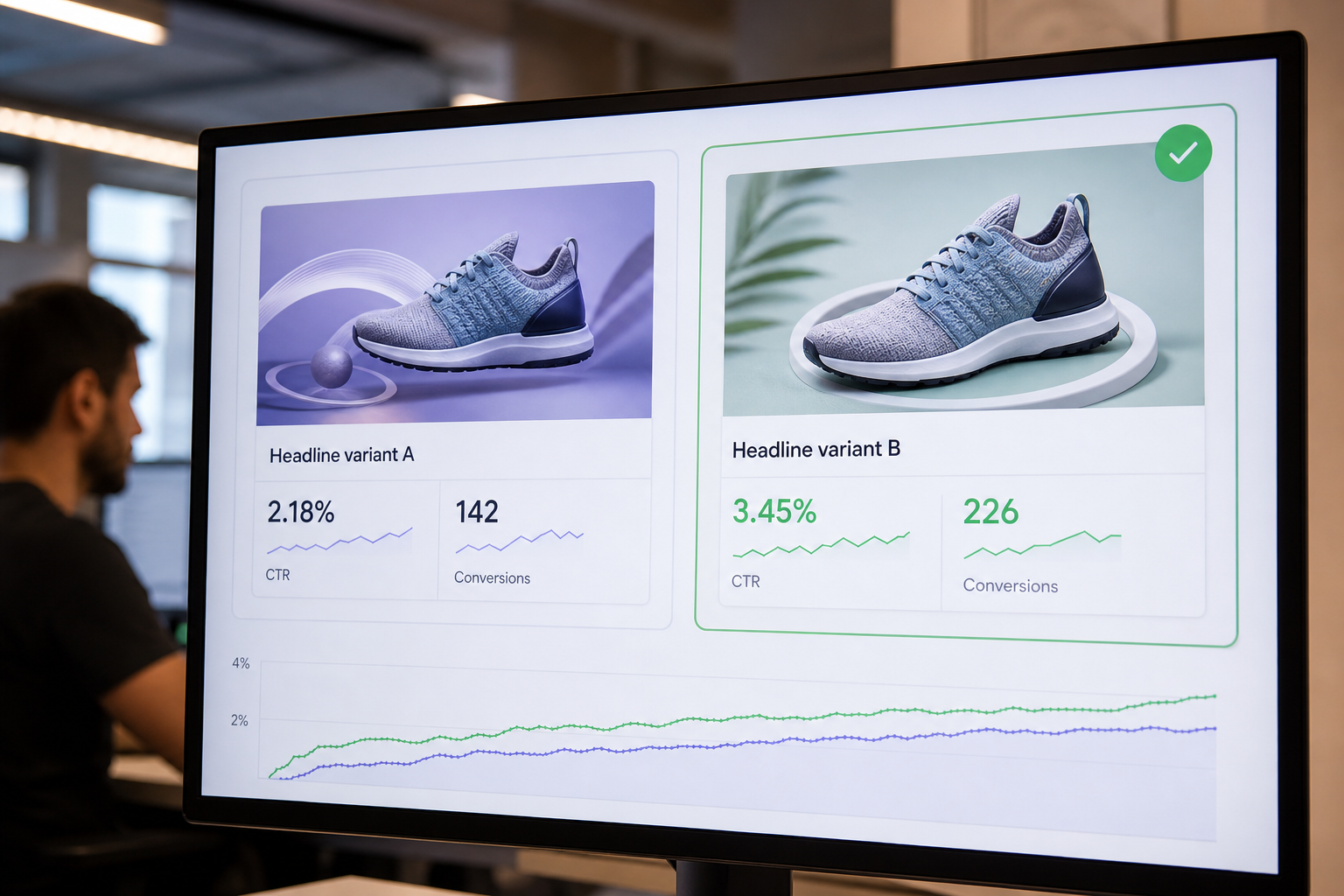
Four Major Paid Advertising Platforms and Their Creative Testing Mechanics
Each paid advertising platform has a distinct creative testing environment. Understanding the native testing mechanics on Google Ads Manager, Meta Ads Manager, LinkedIn Ads Manager, and Snapchat Ads Manager is a prerequisite for running tests that produce reliable signal — not platform artifacts.
Google Ads Manager supports responsive search ads (RSAs), which automatically test combinations of up to 15 headlines and four descriptions. Google's machine learning rotates combinations and surfaces an asset strength score. For more controlled testing, Google's Experiments feature within a Google ad campaign allows true A/B splits at the campaign level, with statistical significance tracking built in. Google Ads Transparency tools also allow advertisers to review what competitors are running — the Google Ads Library surfaces active creatives and is a legitimate source of competitive intelligence.
Meta Ads Manager offers A/B testing natively through its Experiments tool and dynamic creative optimization (DCO), which assembles and tests combinations of up to five images, five headlines, and five descriptions automatically. The Meta Ads Library (also called Ads Library Meta) provides public access to all active ads across Facebook and Instagram, making it possible to audit competitor creative strategies before building test variants. LinkedIn Ads Manager supports creative split testing at the campaign level, with performance breakdowns by audience segment — particularly useful for B2B creative testing where job title and seniority affect creative response rates.
- Google Ads Manager: RSAs test headline/description combinations automatically; Experiments enable manual A/B splits
- Google Ads Library (google ads transparency) surfaces active competitor creatives for benchmarking
- Meta Ads Manager: DCO tests up to 5 images, 5 headlines, and 5 descriptions simultaneously
- Meta Ads Library (ads library meta) provides public visibility into all active ad creatives
- LinkedIn Ads Manager: campaign-level split testing with audience segment breakdowns
- Snapchat Ads Manager: supports creative split testing for video and story formats with swipe-up CTA variants
Three Core Testing Frameworks Every Performance Team Should Know
The A/B test is the most widely used framework. Two variants — one control, one challenger — are exposed to equivalent audience segments simultaneously. The variant that reaches statistical significance on the primary metric wins and becomes the new control. This framework is best for testing single-variable changes where isolating the causal factor matters.
Multivariate testing evaluates combinations of multiple elements simultaneously. While more efficient than sequential A/B tests, multivariate testing requires significantly more traffic and budget to reach significance on each combination. It is best suited for high-volume campaigns on Google Ads or Meta where daily impression counts are in the tens of thousands. Running multivariate tests on low-volume campaigns produces misleading results.
Creative concept testing — sometimes called messaging framework testing — compares fundamentally different value propositions rather than tactical element variations. For example, a campaign might test a price-led angle against a social proof angle against a fear-of-missing-out angle. This type of test informs not just which ad wins, but which positioning resonates with a given audience, making it the highest-signal test type for brand strategy decisions.
- A/B testing: one variable, two variants, simultaneous exposure — best for clean causal signal
- Multivariate testing: multiple elements tested in combination — requires high traffic volume to be valid
- Creative concept testing: compares distinct value propositions or messaging angles, not just elements
- Sequential testing (testing variants one after another) introduces time bias and should be avoided
- Always establish a minimum detectable effect before setting sample size — not after
- 95% statistical confidence is the standard threshold; 90% is acceptable for lower-stakes tests
Five Elements Worth Testing and How to Prioritize Them
Not all creative elements drive equal performance variance. Prioritizing test order by expected impact prevents teams from spending cycles on low-leverage variables while high-impact elements go untested. As a general rule, test the elements most visible at first impression before testing elements encountered deeper in the ad experience.
The headline is consistently the highest-impact element in both search and social ads. On a Google ad campaign, the first headline is the first signal a searcher evaluates. On social media ads, the headline and primary image together determine whether a user stops scrolling. These two elements — headline and hero image — account for the majority of CTR variance and should be the first testing priority for any campaign.
CTAs are frequently undertested despite having a direct, measurable effect on conversion rate. The difference between 'Get a Quote' and 'See Pricing' or 'Start Free' is not semantic — each phrase signals a different level of commitment and attracts users at different funnel stages. Testing CTAs as a standalone variable, especially on landing pages where conversion rate optimization is a priority, can produce 10–30% conversion rate lifts with minimal production investment.
- Headline: highest-impact element in both paid search and social media ads — test first
- Hero image or video thumbnail: determines scroll-stop rate; test visual style, subject, and color palette
- CTA copy: 'Get a Quote' vs. 'See Pricing' vs. 'Start Free' drive materially different conversion rates
- Ad description: secondary impact on CTR; test benefit-led versus feature-led versus social proof framing
- Ad format: video versus static, carousel versus single image — test format when CTR plateaus on element tests
- Landing page alignment: mismatched creative-to-landing-page messaging is a conversion killer, not a creative problem
How to Build a Continuous Creative Testing Program
A one-time test is an experiment. A continuous testing program is a growth engine. The difference is process: a defined testing cadence, a structured creative backlog, clear documentation of winners and losers, and a feedback loop between test results and new creative briefs. Without process, testing becomes reactive and eventually stops when other priorities compete for bandwidth.
A practical cadence for most paid advertising platforms is a four-week test cycle. Week one: define hypothesis and launch test. Weeks two and three: accumulate impressions and let the data run — no optimization decisions during this window. Week four: evaluate results, document learnings, promote the winner to control, and brief the next challenger. This cycle, run consistently, produces 12 or more completed tests per year per campaign — a compounding advantage over competitors running fewer than three.
Creative briefs should capture not just the test parameters but the reasoning behind the hypothesis. Over time, a library of winning and losing variants becomes a proprietary dataset specific to your brand and audience. Platforms like Cube, which have been trained on over $5 million in historical ad spend data across Google, Meta, and other channels, use this type of accumulated creative performance history to accelerate decision-making and reduce the ramp time on new campaigns.
- Define a four-week test cycle with fixed phases: launch, observation, evaluation, iteration
- Maintain a creative backlog with at least four challenger concepts queued at any time
- Document every test result — wins and losses both carry strategic signal
- Brief new challengers based on insights from previous tests, not from instinct
- Rotate winning creatives out of rotation every 4–6 weeks to prevent ad fatigue
- Track creative performance trends alongside audience and bidding data in a single dashboard
Common Mistakes That Invalidate Creative Tests
The most common mistake in digital marketing testing is ending a test too early. Marketers see an early leader and pull the losing variant before the test reaches statistical significance. Early leaders frequently reverse as sample size grows — a well-documented phenomenon in A/B testing called the peeking problem. Committing to a fixed test duration before launch is the single most effective way to prevent this error.
The second most common mistake is testing too many variables simultaneously without the budget to support multivariate analysis. Running five headline variants, three images, and two CTAs in the same test on a $500-per-week campaign produces a result set that looks like data but behaves like noise. Each additional variable exponentially increases the traffic required to reach significance on any single combination.
A third recurring error is misaligning the creative test with the campaign objective. Testing CTR-optimized creative on a campaign optimized for conversions conflates two different signals. An ad that drives high CTR from curious users who do not convert will score well on click metrics while degrading ROAS. The success metric for every creative test must mirror the campaign's actual business objective.
- Ending tests early (peeking problem) is the leading cause of false creative conclusions
- Testing too many variables on low-budget campaigns produces noise, not signal
- Misaligning test metrics with campaign objectives conflates CTR performance with conversion performance
- Running tests sequentially (rather than simultaneously) introduces time-of-week and seasonality bias
- Ignoring the landing page as a variable — creative wins that land on weak pages will not convert
- Failing to document test results means teams repeat the same experiments and never compound learning
Measuring What Matters: Metrics Beyond Click-Through Rate
CTR is the most visible creative metric and the most misleading when treated as the primary success criterion. A headline that drives high CTR from the wrong audience segment can increase cost per acquisition while appearing to 'win' in the dashboard. Every creative test should define a primary metric aligned to business value — typically cost per lead, cost per acquisition, or contribution margin — with CTR tracked as a secondary signal.
ROAS is the standard commercial metric for e-commerce and direct-response campaigns, but it obscures margin when not paired with contribution margin analysis. A creative that drives high-volume low-margin conversions can show strong ROAS while destroying profitability. Marketing directors and CMOs running creative testing programs for multi-location businesses should require that test reporting includes revenue quality metrics, not just volume metrics.
For brand and upper-funnel campaigns — common on LinkedIn Ads Manager or in awareness-stage social media ads — the relevant metrics shift toward video view-through rate, engagement rate, and brand recall lift. These campaigns should not be evaluated on conversion rate. Mixing measurement frameworks across funnel stages is a frequent source of creative testing misinterpretation.
- Primary metric: cost per lead, cost per acquisition, or contribution margin — not CTR alone
- ROAS is a useful directional metric but should always be paired with margin analysis
- Video campaigns: measure view-through rate and completion rate, not just impressions
- Awareness campaigns: brand recall lift and engagement rate are the appropriate success metrics
- Frequency-adjusted CTR surfaces ad fatigue more accurately than raw CTR over time
- Attribution model selection affects which creative appears to win — align attribution to the sales cycle length
| Platform | Native Testing Tool | Best Test Type | Creative Formats Supported | Competitive Intelligence Tool |
|---|---|---|---|---|
| Google Ads Manager | Experiments (A/B) + RSA rotation | Element-level (headlines, descriptions) | Responsive search, display, video, shopping | Google Ads Library (google ads transparency) |
| Meta Ads Manager | Experiments + Dynamic Creative Optimization | Concept-level + multivariate | Single image, video, carousel, stories, reels | Meta Ads Library (ads library meta) |
| LinkedIn Ads Manager | Campaign-level A/B split | Audience segment + creative concept | Single image, video, carousel, message ads | Limited — no public ads library |
| Snapchat Ads Manager | Creative split testing | Format-level (video vs. static) | Snap ads, story ads, collection ads | Limited — no public ads library |
| Google Display / YouTube | Video Experiments (A/B) | Format-level + concept-level | Video (skippable, bumper, in-feed) | Google Ads Library (active campaigns) |
Frequently Asked Questions
-
How do I do creative testing on paid advertising platforms?
Start by defining a single hypothesis and a primary success metric before launching any test. Isolate one creative variable — headline, image, or CTA — and run two variants simultaneously to equivalent audience segments. Set a minimum test duration of two to four weeks and a sample size threshold before reviewing results. End the test only after reaching statistical significance, typically at a 95% confidence level, then document findings and build the next challenger based on what you learned. -
What is Meta Ads Manager and how does it support creative testing?
Meta Ads Manager is Meta's native campaign management platform for running ads across Facebook, Instagram, and the Meta Audience Network. For creative testing, it offers two primary tools: the Experiments feature for controlled A/B splits and Dynamic Creative Optimization, which automatically assembles and tests combinations of up to five headlines, five images, and five descriptions. The Meta Ads Library provides public access to all active creatives, making it a useful benchmarking tool before building test variants. -
What is the Google Ads Library and how is it used for competitive research?
The Google Ads Library, accessible through the Google Ads Transparency Center, is a public database of active Google ad campaigns. Advertisers use it to audit competitor headlines, messaging angles, and creative formats before building their own test variants. Reviewing competitor creative through this tool — sometimes referenced as google ad transparency — helps identify gaps in the market and informs stronger challenger concepts for your own creative testing program. -
How long should a creative test run on social media ads?
Most creative tests on social media ads should run for a minimum of two weeks and ideally four weeks. Ending tests earlier introduces the peeking problem, where early performance leaders frequently reverse as the sample size grows. The appropriate duration depends on daily impression volume and the minimum detectable effect size required for the test to be statistically valid. Low-budget campaigns need longer windows; high-volume campaigns can reach significance faster. -
What is conversion rate optimization and how does it relate to ad creative testing?
Conversion rate optimization (CRO) is the practice of systematically improving the percentage of visitors who take a desired action on a website or landing page. It relates directly to ad creative testing because the creative sets user expectations — a winning ad that lands on a weak or misaligned page will not convert. CRO and creative testing work as a connected system: creative testing optimizes the top of the click funnel, while CRO optimizes what happens after the click. -
What is the difference between Google Ads Manager and Google Ad Center?
Google Ads Manager (formerly DoubleClick) is a professional campaign management and reporting platform used by agencies and large advertisers to manage multiple accounts and run advanced testing. Google Ad Center is a consumer-facing privacy tool that allows users to control the types of ads they see. For paid advertising and creative testing purposes, the relevant platform is Google Ads Manager, which contains the Experiments feature, RSA asset reporting, and performance breakdowns used in structured creative tests. -
How often should ad creatives be refreshed to prevent ad fatigue?
On high-frequency platforms like Meta and Instagram, top-performing creatives should be refreshed or rotated every four to six weeks to prevent ad fatigue. Signs of fatigue include rising frequency scores, falling CTR, and increasing cost per acquisition despite stable bidding and targeting. Maintaining a creative backlog with at least four challenger concepts queued at any time ensures that a tested replacement is ready before fatigue degrades performance, protecting ROAS over time. -
What does digital marketing testing involve beyond A/B tests?
Digital marketing testing encompasses A/B testing, multivariate testing, creative concept testing, landing page testing, and audience segmentation testing. In the context of paid advertising, it also includes bid strategy experiments, campaign structure tests, and attribution model comparisons. The most impactful testing for most growth-stage brands is creative concept testing — comparing distinct value propositions — because it produces both tactical winners and strategic insights about audience positioning that inform broader campaign decisions.