
Blog
Listicle
5 Best Paid Ads Platforms for Smarter Ad Management in 2026
Wasted ad spend is not a budget problem — it is a platform and execution problem. Brands running campaigns across Google, Meta, and LinkedIn without a clear platform strategy routinely overpay for clicks that never convert.
Choosing the right paid ads platform in 2026 means matching your audience, funnel stage, and business model to the network best engineered for that job. Google Ads dominates high-intent search. Meta Ads reaches broad consumer audiences at scale. Each platform rewards a different kind of advertiser.
This guide ranks the five best paid advertising platforms available today, scored on targeting depth, campaign types, ROAS potential, and real-world manageability. Whether you run a single location or operate across dozens of markets, the right online ads platform is the fastest lever you have on customer acquisition cost.
What Are Paid Ads Platforms?
Paid ads platforms are advertising networks that let businesses bid to show promotional content to targeted audiences across search, social, display, and shopping environments. Each platform uses its own auction model, targeting signals, and ad formats. The best paid advertising platforms combine precise audience data with flexible campaign types — giving advertisers control over spend, placement, and conversion tracking from a single management interface.
Methodology: How We Ranked These 5 Paid Ad Platforms
Every platform on this list was evaluated against five criteria that reflect real advertiser priorities in 2026: audience reach and targeting depth, available campaign types, ROAS potential based on published industry benchmarks, ease of campaign management, and fit for multi-location or multi-market brands.
Platforms were scored on each criterion and ranked by overall weighted performance. Intent strength was weighted most heavily — a platform that captures buyers already searching for your product will almost always outperform one that interrupts a passive scroll, all else being equal.
Cost per click alone was not a ranking factor. A higher CPC on a platform that converts at 8% beats a low CPC that converts at 0.5%. The rankings below reflect that logic throughout.
- Criterion 1: Audience reach and targeting precision
- Criterion 2: Campaign type variety (search, display, shopping, video, local)
- Criterion 3: Documented ROAS benchmarks by industry
- Criterion 4: Campaign management complexity and tooling quality
- Criterion 5: Multi-location and local targeting capability
#1 Google Ads — Best Overall Paid Advertising Platform
Google Ads earns the top rank because it captures demand that already exists. When a buyer types 'emergency HVAC repair near me' or 'best dental implants in Toronto,' Google Ads puts your offer directly in front of that intent. No other paid ads platform matches that conversion proximity.
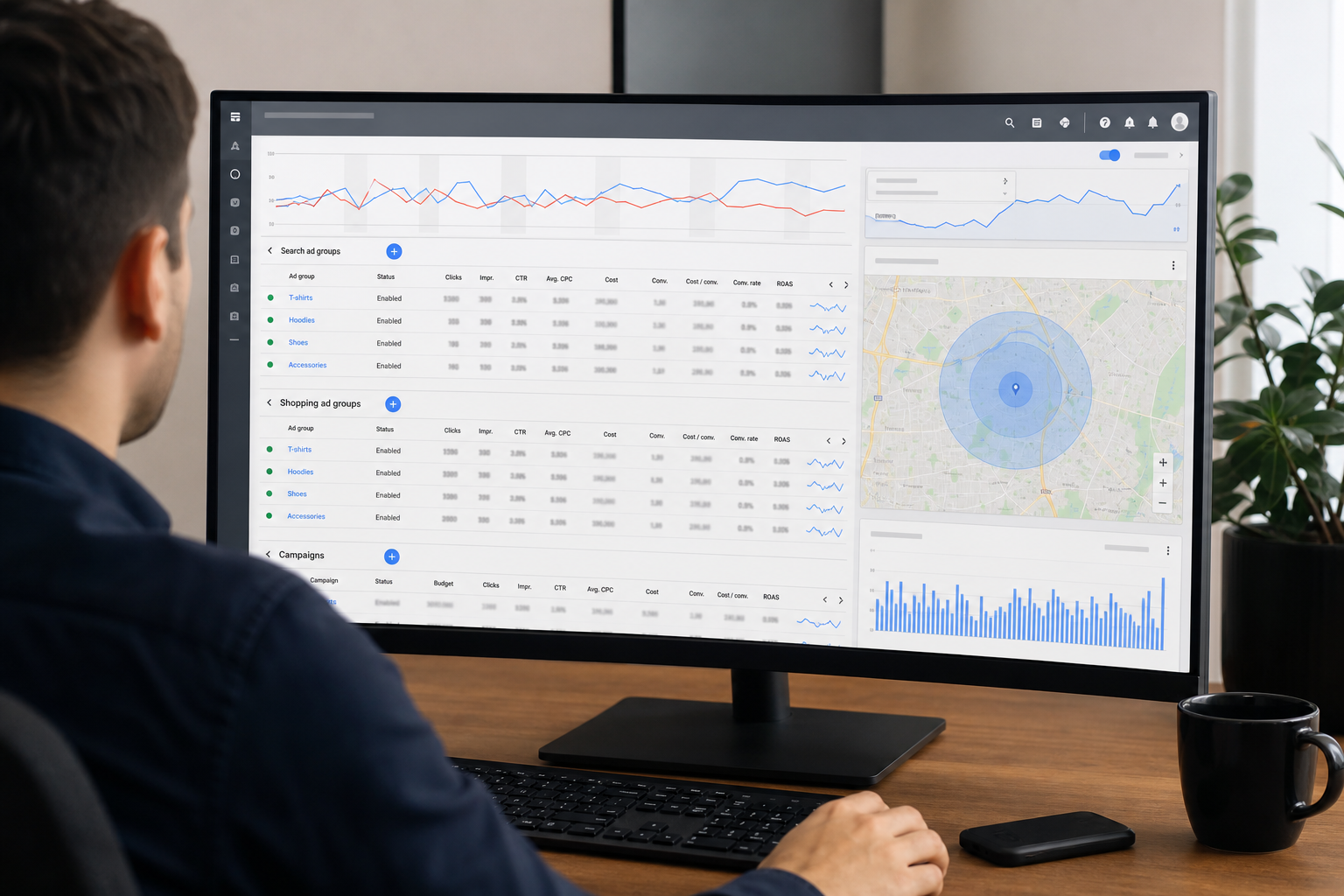
Google Ads management covers the widest range of campaign types of any platform: search, Google display ads, Google Shopping ads, video (YouTube), Google local ads, Local Service Ads, Performance Max, and Google remarketing. This breadth means a single account can follow a buyer from awareness to purchase without leaving the Google ecosystem.
The Google Ads manager interface supports granular bid strategies, audience layering, and conversion tracking that integrates directly with Google Analytics 4. Google Ads Editor enables bulk campaign changes offline, which is essential for agencies and multi-location operators managing hundreds of ad groups simultaneously.
- Campaign types: Search, Display, Shopping, Video, Performance Max, Local Service Ads, Demand Gen
- Targeting: Keywords, audiences, locations, device, dayparting, customer match, and remarketing lists
- Google Ads remarketing: Reconnects with site visitors and CRM lists across Search and Display networks
- Google Shopping ads: Product-feed-driven placements for e-commerce and retail brands
- Local Service Ads: Pay-per-lead format for home services, healthcare, and legal verticals
- Management tools: Google Ads Manager, Google Ads Editor, API access for enterprise-scale automation
#2 Meta Ads Manager — Best for Audience Scale and Retargeting
Meta Ads Manager ranks second because no other platform gives advertisers access to 3 billion-plus monthly active users with behavioral, interest, and social-graph targeting in a single interface. For consumer brands, hospitality groups, restaurants, and retail chains, Meta is the reach engine that feeds the top of the funnel.
The platform spans Facebook business ads, Instagram, Messenger, and the Audience Network — all managed from the ads manager Meta interface. Campaign objectives map cleanly to funnel stages: awareness, traffic, engagement, leads, app promotion, and sales. Facebook ads strategy built around lookalike audiences and retargeting sequences consistently drives lower CPAs than broad prospecting alone.
The Meta Ads Library gives advertisers and researchers full visibility into every active ad across the network — a transparency feature that makes competitive intelligence straightforward. Advantage+ campaigns use machine learning to automate audience expansion and creative testing, reducing manual workload while maintaining performance.
- Placements: Facebook Feed, Instagram Feed, Stories, Reels, Messenger, Audience Network
- Targeting: Interests, behaviors, demographics, custom audiences, lookalike audiences, retargeting pixels
- Meta Ads Library: Public database of all active ads across Meta properties for competitive research
- Advantage+ Shopping Campaigns: Automated product catalog ads optimized for conversion
- Creative testing: Dynamic creative and A/B testing built natively into campaign setup
- Facebook ads strategy: Funnel-mapped campaign objectives from awareness through purchase
#3 Google Local Service Ads — Best Local Ads Platform for Service Businesses
Local Service Ads (LSAs) from Google occupy a distinct category because they operate on a pay-per-lead model rather than pay-per-click. For home services, healthcare practices, legal firms, and other local service providers, LSAs deliver verified phone calls and message leads — not just impressions or clicks that may or may not convert.
LSA listings appear above standard Google search ads and organic results, making them the most visible real estate on the search results page for covered verticals. The Google Ads certification and background-check badge (Google Guaranteed or Google Screened) displayed on LSA listings builds trust signals that paid search ads alone cannot replicate.
For multi-location businesses, LSAs can be configured per service area, allowing each location to capture local ads Google traffic independently. Combined with a well-maintained Google Business Profile, LSAs create a compounding local search presence that is difficult for competitors to displace.
- Pricing model: Pay per verified lead (call or message) — not per click
- Placement: Above all other Google search ads and organic results
- Verticals covered: Home services, healthcare, legal, financial advisors, real estate, and more
- Google Guaranteed badge: Background-checked verification that increases consumer trust
- Multi-location support: Individual service-area targeting per business location
- Integration: Works alongside standard Google Ads campaigns for full-funnel local coverage
#4 LinkedIn Ads — Best Paid Platform for B2B and Professional Audiences
LinkedIn Ads ranks fourth on reach but first on B2B targeting precision. No other paid ads platform lets you filter audiences by job title, seniority, company size, industry, and professional skills simultaneously. For SaaS companies, professional services firms, and enterprise vendors, a LinkedIn Ads campaign reliably reaches economic buyers rather than passive browsers.
Available formats include Sponsored Content (single image, carousel, video), Sponsored Messaging (InMail and Conversation Ads), Lead Gen Forms, and Dynamic Ads. Lead Gen Forms are particularly valuable — they pre-fill with LinkedIn profile data, which reduces form friction and consistently lifts lead volume without requiring a separate landing page.
CPCs on LinkedIn are higher than most platforms. Average costs range from $5 to $15 per click depending on audience and format. The payoff is that the leads tend to be better-qualified, which compresses cost-per-pipeline-opportunity and improves LTV:CAC ratios for high-ticket products and services.
- Targeting: Job title, company size, industry, seniority, skills, LinkedIn groups, and company lists
- Campaign types: Sponsored Content, Message Ads, Lead Gen Forms, Dynamic Ads, Text Ads
- LinkedIn Ads campaign objectives: Awareness, consideration, and conversions mapped to funnel stage
- Lead Gen Forms: Native forms pre-filled with LinkedIn profile data — reduces friction significantly
- Matched Audiences: Upload CRM lists, retarget site visitors, and target account lists for ABM
- CPC range: $5–$15 per click, offset by higher lead quality and lower cost-per-qualified-opportunity
#5 Microsoft Advertising (Bing Ads) — Best Underutilized Paid Search Platform
Microsoft Advertising — formerly Bing Ads — ranks fifth and is consistently underutilized. Bing powers search across Microsoft Edge, Yahoo, and partner networks, capturing an audience that skews older, higher-income, and more likely to be a B2B decision-maker than the average Google searcher. Average CPCs on Microsoft Advertising run 20–35% lower than equivalent Google Ads campaigns.
The platform supports search ads, Microsoft Shopping Campaigns (parallel to Google Shopping ads), audience ads on the Microsoft Audience Network, and LinkedIn profile targeting layered on top of search — a unique capability no other platform offers. Import from Google Ads is one-click, reducing setup time to near zero for advertisers already running Google campaigns.
For multi-location brands spending heavily on Google Ads, Microsoft Advertising adds incremental reach with minimal additional management overhead. It is not a replacement for Google Ads management; it is an efficient extension of it.
- CPCs: Typically 20–35% lower than Google Ads for comparable keywords
- Unique feature: LinkedIn profile targeting layered onto search campaigns
- Campaign types: Search, Shopping, Audience Ads (display), and Performance Max equivalents
- One-click import: Migrates existing Google Ads campaigns directly into Microsoft Advertising
- Audience demographics: Skews 35+, higher household income, and strong B2B decision-maker index
- Network reach: Bing, Yahoo, AOL, MSN, Microsoft Edge, and partner sites
Three Questions to Pick the Right Paid Ads Platform for Your Business
Choosing among paid advertising platforms starts with three questions that no CPC benchmark can answer for you. Get these right and the platform choice becomes straightforward.
First: Where does your buyer's purchase journey begin? If they search with intent ('book HVAC tune-up near me'), Google Ads and Local Service Ads win. If they discover your product passively (scrolling, watching, browsing), Meta or LinkedIn serves you better.
Second: What is your average deal size and sales cycle? High-ticket B2B products with long sales cycles belong on LinkedIn, where you can target economic buyers directly. Fast-moving consumer goods with short purchase cycles belong on Meta or Google Shopping ads, where volume and speed matter more than surgical targeting.
Third: Do you have the operational capacity to manage campaigns well? A sophisticated platform poorly managed delivers worse ROAS than a simpler platform run with discipline. Cube, backed by Sequoia Capital and built by Stanford GSB and IIT alumni, manages paid ads across Google, Meta, Bing, and Amazon using a hybrid model of autonomous AI agents and human strategists — eliminating the operational gap that causes most brands to underperform on every platform they touch.
- Question 1: Where does your buyer's purchase journey begin — search intent or passive discovery?
- Question 2: What is your average order value or deal size, and how long is the sales cycle?
- Question 3: Do you have the internal capacity to manage campaigns with the discipline each platform requires?
- Signal: High-intent search + local targeting = Google Ads or Local Service Ads
- Signal: Consumer brand + broad reach + retargeting = Meta Ads Manager
- Signal: B2B or professional services + high deal value = LinkedIn Ads campaign
| Platform | Best For | Campaign Types | Avg. CPC Range | Multi-Location Support |
|---|---|---|---|---|
| Google Ads | High-intent search, shopping, full-funnel | Search, Display, Shopping, Video, LSA, PMax | $1–$6 (search) | Strong — location targeting, LSA per area |
| Meta Ads Manager | Consumer awareness, retargeting, social reach | Image, Video, Carousel, Lead Gen, Stories | $0.50–$3 | Strong — geo and radius targeting per location |
| Google Local Service Ads | Local service businesses, pay-per-lead | Local lead ads only | Pay-per-lead ($20–$150) | Excellent — per-location service area setup |
| LinkedIn Ads | B2B, professional services, enterprise sales | Sponsored Content, InMail, Lead Gen Forms | $5–$15 | Moderate — company and geo targeting available |
| Microsoft Advertising | Supplemental search reach, B2B audiences | Search, Shopping, Audience Ads | $0.80–$4 (search) | Moderate — mirrors Google Ads setup via import |
Frequently Asked Questions
-
What are the best paid ads platforms for small and multi-location businesses?
Google Ads and Meta Ads Manager are the strongest starting points for most businesses. Google Ads captures existing search intent, while Meta delivers broad reach and retargeting at scale. Multi-location businesses should also evaluate Google Local Service Ads, which operate on a pay-per-lead model and allow independent service-area targeting per location — reducing wasted impressions significantly. -
What is the difference between Google Ads Manager and Meta Ads Manager?
Google Ads Manager is the interface for managing paid search, display, shopping, and video campaigns across Google's network. Meta Ads Manager handles paid campaigns across Facebook, Instagram, Messenger, and the Audience Network. Google captures active search intent; Meta targets audiences based on interests, behaviors, and social data. Most performance-focused brands use both platforms together for full-funnel coverage. -
How do Local Service Ads differ from standard Google Ads?
Local Service Ads charge per verified lead — a phone call or message from a real potential customer — rather than per click. They appear above all standard Google search ads and require a background check and Google Guaranteed or Screened badge. This makes them particularly cost-effective for home services, healthcare, and legal businesses focused on measurable ROI rather than traffic volume. -
What are the main types of Google Ads campaigns?
Google Ads supports seven primary campaign types: Search, Display, Shopping, Video (YouTube), Performance Max, Local Service Ads, and Demand Gen. Each maps to a different funnel stage and buying behavior. Search targets active intent; Display and Demand Gen build awareness; Shopping ads drive e-commerce product sales; Performance Max uses machine learning to optimize placements automatically across all Google channels. -
How does Google Ads remarketing work?
Google Ads remarketing shows ads to users who previously visited your website, used your app, or appear on your customer list. Remarketing lists can be segmented by pages visited, time on site, or purchase behavior. These audiences are then targeted across Google Search, Display, YouTube, and Shopping campaigns — typically achieving higher conversion rates and lower CPAs than cold prospecting campaigns. -
Is LinkedIn Ads worth the higher CPC for B2B campaigns?
For B2B brands with high average deal values, LinkedIn Ads consistently delivers a lower cost-per-qualified-lead despite higher CPCs. The platform's job title, seniority, and company-size targeting ensures ads reach economic buyers rather than general audiences. Brands selling products or services above $5,000 in deal value typically see LinkedIn's cost-per-pipeline-opportunity outperform Google or Meta for B2B objectives. -
What is the Meta Ads Library and how can advertisers use it?
The Meta Ads Library is a public, searchable database of every active ad running across Facebook, Instagram, and other Meta platforms. Advertisers use it to analyze competitor creative strategies, identify messaging trends in their industry, and audit their own active campaigns. It is one of the most accessible competitive intelligence tools available on any paid advertising platform, available at no cost. -
How should multi-location brands manage paid ads across multiple platforms?
Multi-location brands need a unified campaign architecture that maintains consistent brand messaging while allowing location-level targeting and budget control. Practically, this means separate ad groups or campaigns per location on Google Ads, geo-targeted ad sets on Meta, and individual LSA profiles per service area. Centralizing this under one management system — whether in-house or through a managed service — prevents budget fragmentation and data gaps across locations.