
Blog
Complete Guide
The Complete Guide to On-Page SEO: Factors, Tips & Checklist

On-page SEO is the discipline that sits between writing content and earning traffic. Get it wrong, and even well-researched pages stay buried on page three. Get it right, and your service pages become compounding organic assets that drive leads month after month.
This guide covers every dimension of on-page SEO: what it is, how it differs from off-page and technical SEO, which ranking factors carry the most weight, and how to apply a repeatable optimization checklist to any page on your site.
Whether you are optimizing a single landing page or rolling out a strategy across multiple locations, the principles here apply. The goal is to give you the complete map, with links to deeper resources where the territory gets complex.
What Is On-Page SEO?
On-page SEO (also called on-site SEO) is the practice of optimizing individual web pages so that search engines can accurately understand their topic, relevance, and quality, and so users find them genuinely useful. It covers every element you control directly on the page itself: title tags, meta descriptions, header tags, body content, URL structure, internal links, image alt text, and structured data. On-page SEO is distinct from off-page SEO, which involves external signals like backlinks, and from technical SEO, which addresses site infrastructure like crawlability and page speed.
The Four Types of SEO and Where On-Page Fits
Search engine optimization is not a single tactic. It is a system of four distinct disciplines, each targeting a different layer of how search engines discover, evaluate, and rank content. Understanding where on-page SEO sits within this system is the foundation for building any effective strategy.
The four types of SEO are on-page SEO, off-page SEO, technical SEO, and local SEO. On-page SEO controls what a page says and how it says it. Off-page SEO builds the external authority that tells search engines a page is worth trusting. Technical SEO ensures the site infrastructure lets search engines crawl and index pages without friction. Local SEO targets geographic relevance, particularly in Google Maps and local pack results.
For multi-location businesses, all four types interact constantly. A page can be perfectly optimized on-page but fail to rank if technical issues block indexing or if the domain lacks backlink authority. The on-page layer is the one you control most directly and where improvements produce the fastest measurable results.
- On-page SEO: title tags, headers, content quality, keyword placement, internal links, structured data
- Off-page SEO: backlinks, brand mentions, domain authority signals, seo guest posting service coverage
- Technical SEO: crawlability, page speed, Core Web Vitals, site architecture, canonical tags
- Local SEO: Google Business Profile optimization, NAP consistency, local citations, proximity signals
- On-page and off-page SEO together form the visible, user-facing half of a complete search strategy
What Is On-Page SEO? The Foundation Every Optimizer Needs
On-page SEO begins with a simple principle: every element on a webpage either helps or hurts a search engine's ability to understand what that page is about and whether it deserves to rank for a given query. The job of on-page optimization is to remove every ambiguity and signal relevance as clearly as possible.
At its most fundamental level, on-page SEO is about alignment. The keyword in your title tag should match the keyword in your H1, which should match the primary topic of your body content. When that alignment breaks down, Google's ability to classify your page weakens and rankings suffer.
On-page SEO also bridges directly into user experience. A page with clear header hierarchy, concise paragraphs, and relevant internal links keeps visitors engaged longer, which itself feeds positive behavioral signals back to Google. The discipline is as much about human readers as it is about crawlers.
- Title tag: the single most important on-page signal for communicating a page's target keyword
- Meta description: does not directly influence rankings but drives click-through rate from search results
- H1 and header hierarchy: structures the page's topic for both crawlers and readers
- Body content: must address search intent completely, not just contain target keywords
- Image alt text: makes visual content readable to search engines and improves accessibility
- Internal linking: distributes page authority across the site and guides crawlers to related content
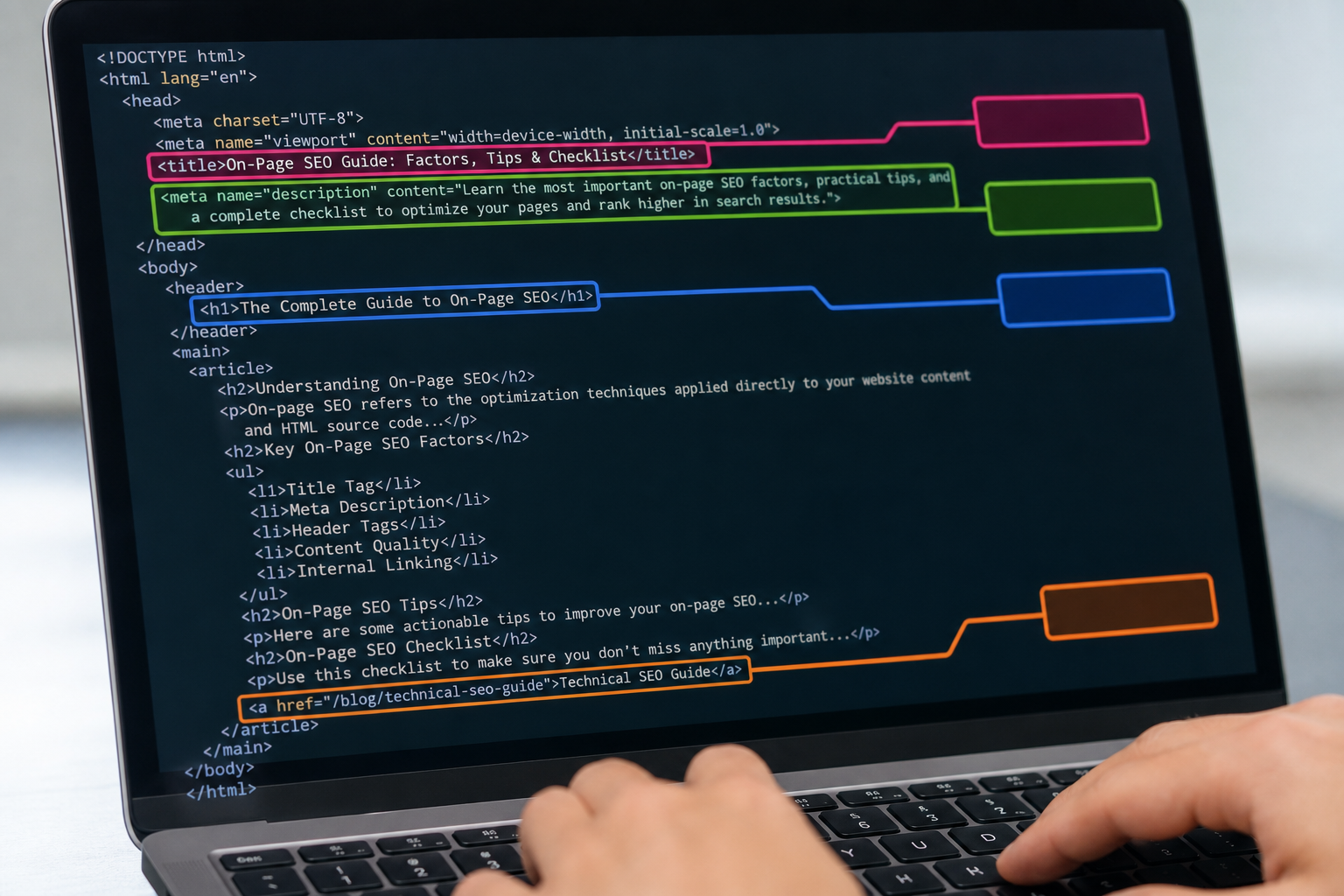
Eight Core On-Page SEO Factors That Move Rankings
Not all on-page elements carry equal weight. Some, like title tags and header structure, have a direct and well-documented influence on how Google classifies a page. Others, like structured data and properly optimized URL slugs, are high-leverage when combined with strong content but have limited impact in isolation.
The 80/20 rule in SEO is real: roughly 80% of your ranking gains come from getting 20% of the factors right. For most pages, that 20% is title tag accuracy, content depth relative to search intent, header hierarchy, and internal link structure. Mastering these four before fine-tuning image alt text or schema markup is the efficient path.
Below are the eight on-page SEO factors that consistently drive measurable ranking improvements, drawn from ranking studies and corroborated by practitioner experience across thousands of pages.
- Title tag: 50 to 60 characters, primary keyword near the front, unique per page
- Meta description: 140 to 160 characters, includes secondary keyword, written as a value proposition
- URL structure: short, keyword-rich, hyphenated slugs (properly optimized URL examples use no stop words)
- Header tags (H1 to H3): one H1 per page, subheadings that map to keyword clusters and logical hierarchy
- Content depth and search intent match: answers the full query, not just the head keyword
- Internal linking: links to and from related service pages using descriptive anchor text
On-Page SEO vs. Off-Page SEO vs. Technical SEO: Key Differences
The difference between on-page SEO, off-page SEO, and technical SEO is the most common point of confusion for teams starting to build a search strategy. Conflating them leads to misallocated effort, like writing more content when the real problem is a crawl block or a thin backlink profile.
On-page SEO is entirely within your control and affects how well a page communicates its relevance. Off-page SEO is partially within your control and affects how authoritative search engines consider your domain. Technical SEO is mostly within your control and affects whether your pages can be found and rendered at all.
Off-page SEO vs. technical SEO is worth stating clearly: technical SEO is a prerequisite, off-page SEO is a multiplier. A site with unresolved technical issues will not fully benefit from backlinks. A technically sound site with zero external links will still struggle to rank for competitive queries.
- On-page SEO: content, tags, URL, headers, internal links, structured data, controlled on the page itself
- Off-page SEO: backlinks, digital PR, brand citations, seo guest post service placements, social signals
- Technical SEO: site speed, crawlability, indexation, mobile-friendliness, Core Web Vitals, canonical tags
- On-page and off-page SEO together determine relevance and authority, the two core ranking dimensions
- Technical SEO is the foundation; without it, on-page and off-page work delivers diminished returns
- Local SEO adds a fourth layer: geographic proximity and Google Business Profile optimization signals
The On-Page SEO Checklist: Twelve Steps to a Fully Optimized Page
A repeatable checklist removes the guesswork from optimization. The following steps cover every element a page needs before it is ready to compete in search results. Apply this checklist to new pages before publication and to existing pages during quarterly audits.
Start with the structural elements: title tag, meta description, URL, and H1. These four communicate the page's topic to Google before a single sentence of body copy is read. If these are misaligned, no amount of content quality will fully compensate.
Then move to content depth, keyword distribution, and internal linking. Finally, validate technical hygiene: check that the page is indexable, loads within Core Web Vitals thresholds, and has no broken links. Use website audit tools to automate the technical validation step.
- Write a unique title tag with the primary keyword in the first 60 characters
- Draft a meta description that includes a secondary keyword and a clear reason to click
- Set a clean, keyword-rich URL slug with no dynamic parameters or stop words
- Use one H1 that matches the page's target keyword and search intent, with logical H2 and H3 subheadings
- Place the primary keyword naturally within the first 100 words and add descriptive alt text to every image
- Confirm the page returns a 200 status (not a default 404 page), passes Core Web Vitals, and links internally to at least two related pages
Three Common On-Page SEO Mistakes That Kill Rankings
Most on-page SEO failures are not caused by missing tactics. They are caused by a small number of recurring mistakes that undermine the signals Google needs to confidently rank a page. Identifying and fixing these mistakes typically delivers faster ranking improvements than adding new optimizations.
Keyword stuffing is the most persistent mistake, even among experienced teams. Repeating a keyword unnaturally across a page does not reinforce relevance, it triggers over-optimization penalties and degrades the user experience. The correct approach is to use the primary keyword in the title, H1, and first paragraph, then rely on semantically related terms throughout the body.
The second and third most common mistakes are thin content and broken internal link structures. A page that technically addresses a topic but provides only surface-level coverage will not satisfy search intent. Broken internal links or pages returning a default 404 error silently destroy link equity and frustrate both users and crawlers.
- Keyword stuffing: unnatural keyword repetition that reads poorly and triggers over-optimization signals
- Thin content: pages that mention a topic without covering it with sufficient depth or specificity
- Duplicate title tags: multiple pages with identical title tags competing for the same keyword
- Missing or generic meta descriptions: reduces click-through rate from search results pages
- Broken internal links or 404 errors: leak link equity and interrupt crawl paths across the site
- Ignoring search intent: optimizing for a keyword without matching the format users expect
On-Page SEO Tools: What to Use and When
A strong on-page SEO workflow relies on three categories of tools: content optimization platforms, website audit tools, and ranking and traffic monitors. Each serves a different function in the optimization cycle and works best in combination with the others.
For content optimization, tools like Surfer SEO and Clearscope analyze top-ranking pages for a keyword and generate recommendations for content structure, word count, and semantic coverage. For technical on-page auditing, Screaming Frog and Ahrefs Site Audit identify missing tags, broken links, and crawl issues at scale. A website backlink checker is essential for the off-page layer once on-page is solid.
For ongoing ranking visibility, a reliable website ranking checker lets you track keyword position changes over time and connect on-page changes to measurable ranking shifts. Website DA checker and website DA PA checker tools from Moz and Ahrefs provide domain-level authority context for understanding why pages rank where they do.
- Surfer SEO / Clearscope: content optimization and semantic keyword recommendations
- Screaming Frog / Ahrefs Site Audit: on-page technical audit, crawl error detection, missing tag identification
- Google Search Console: index coverage, click-through rate data, and Core Web Vitals reporting
- Website ranking checker: tracks keyword position changes tied to specific on-page updates
- Website backlink checker: monitors external link profile for off-page authority context
- Website DA checker / website DA PA checker: benchmarks domain authority against competitors
On-Page SEO for Multi-Location Businesses: Scale Without Sacrificing Quality
Multi-location businesses face an on-page SEO challenge that single-site brands do not: producing location-specific pages that are genuinely unique, locally relevant, and optimized for each market without duplicating content across dozens of URLs. Generic location pages with swapped city names are one of the most common causes of thin content penalties in this segment.
The solution is a location page architecture that combines a shared structural template with location-specific content blocks: local keyword targeting, area-specific proof points, locally relevant FAQs, and embedded Google Maps. Each page should target the specific city or neighborhood search intent, not just a brand name plus location name.
Cube, backed by Sequoia Capital and built by Stanford GSB and IIT alumni, offers managed on-page SEO services designed specifically for multi-location brands. Its AI-Human Harmony model automates the page audit and optimization layer while human strategists ensure each location page serves genuine local search intent. Brands using this system typically see measurable organic traffic growth within 90 days.
- Create a unique H1 and title tag for each location page targeting the specific city-level keyword
- Include location-specific body content: local service areas, staff names, and locally relevant proof points
- Embed LocalBusiness structured data on every location page with accurate NAP data
- Add a location-specific FAQ section addressing questions users in that market actually search
- Interlink all location pages through a master locations hub page to consolidate internal link equity
- Audit location pages quarterly using website audit tools to catch duplicate tags and 404 errors
| SEO Type | Where It Lives | Primary Signals | Overlap With On-Page | Typical Tools |
|---|---|---|---|---|
| On-Page SEO | Directly on the webpage | Title tags, headers, content, internal links, structured data | Core discipline — all other types support it | Surfer SEO, Screaming Frog, Google Search Console |
| Off-Page SEO | External websites and platforms | Backlinks, brand mentions, seo guest post service placements | External authority amplifies on-page relevance signals | Website backlink checker, Ahrefs, Semrush |
| Technical SEO | Site infrastructure and server | Crawlability, page speed, Core Web Vitals, canonical tags | Technical health is a prerequisite for on-page gains | Screaming Frog, Google Search Console, Ahrefs Site Audit |
| Local SEO | Google Business Profile and local citations | NAP consistency, proximity, reviews, local structured data | Location pages are on-page assets optimized for local intent | Google Business Profile, Moz Local, BrightLocal |
Frequently Asked Questions
-
What is on-page SEO?
On-page SEO is the practice of optimizing elements directly on a webpage, including title tags, meta descriptions, headers, body content, URL structure, and internal links, so search engines can accurately understand the page's topic and rank it for relevant queries. Unlike off-page SEO, which relies on external signals like backlinks, on-page SEO is entirely within the site owner's control and is the fastest layer to improve. -
What are the 4 types of SEO?
The four types of SEO are on-page SEO, off-page SEO, technical SEO, and local SEO. On-page covers content and tags on the page itself. Off-page covers external authority signals like backlinks. Technical SEO addresses site infrastructure like crawlability and speed. Local SEO focuses on geographic visibility through Google Business Profiles, local citations, and proximity signals. Effective search strategies require all four working together. -
What is the difference between on-page SEO and off-page SEO?
On-page SEO involves optimizations you make directly on your website, such as title tags, content quality, and internal linking. Off-page SEO refers to external signals, primarily backlinks and brand mentions, that tell search engines your domain is authoritative. On-page establishes relevance; off-page builds authority. Both are necessary for competitive rankings, but on-page is the foundation you build first before pursuing link acquisition. -
What is the 80/20 rule in SEO?
The 80/20 rule in SEO refers to the principle that roughly 80% of your organic traffic gains come from optimizing 20% of your pages or ranking factors. In practice, this means prioritizing title tags, content depth, header structure, and internal linking over secondary elements like image compression or breadcrumb schema. Identifying your highest-potential pages and optimizing those first produces faster, more measurable results than spreading effort evenly. -
What are the 3 C's of SEO?
The 3 C's of SEO are Content, Code, and Credibility. Content covers on-page optimization, including keyword relevance, depth, and structure. Code refers to the technical layer: clean HTML, fast load times, and crawlable site architecture. Credibility encompasses off-page signals, particularly the quality and quantity of backlinks pointing to your domain. All three must be strong for a page to rank competitively in modern search results. -
What does an on-page SEO checklist include?
A complete on-page SEO checklist includes a unique keyword-targeted title tag, a compelling meta description, a clean URL slug, one H1 per page, logically structured subheadings, keyword placement in the first 100 words, descriptive image alt text, internal links with descriptive anchor text, structured data markup, a confirmed 200 HTTP status with no default 404 page, and validation through website audit tools for crawl errors and Core Web Vitals compliance. -
What is the difference between on-page SEO, off-page SEO, and technical SEO?
On-page SEO optimizes what a page says and how it is structured. Off-page SEO builds the external authority that signals trustworthiness to search engines. Technical SEO ensures pages can be crawled, indexed, and rendered correctly. The three disciplines are sequential in priority: technical issues block all other gains, on-page signals communicate relevance once the crawl path is clear, and off-page authority then amplifies those rankings further. -
What are on-page SEO factors?
Core on-page SEO factors include the title tag, meta description, URL structure, H1 and subheading hierarchy, body content depth, keyword distribution, image alt text, internal linking structure, and structured data markup. Among these, title tag accuracy, content-to-intent match, and internal linking typically produce the highest ranking impact and should be prioritized in any optimization effort before moving to secondary technical refinements.