


Sometimes, a good email campaign underperforms because of one small detail. It could be the subject line, CTA, send time, or even where the most important information appears.
The problem is that when you change several things at once, it becomes difficult to know what actually worked. A/B testing gives you a clearer answer. You compare two versions, see which one performs better, and use what you learn to improve future emails.
In this blog, we’ll cover simple A/B testing ideas that can help you increase email open rate, improve email click-through rate, and make your overall email marketing optimization more effective.
Why A/B Testing Matters for Email Performance
A/B testing compares two versions of an email by changing one key element. For example, Version A may use your usual subject line, while Version B tests a shorter or more benefit-focused option.
The goal is not to change everything at once. It is to understand what your audience responds to.
One successful test will not automatically double every email result. But small improvements across subject lines, CTAs, layouts, and send times can add up over several campaigns.
You also need to look at the right metric. Open rates can help you understand whether the subject line is getting attention. Clicks and conversions tell you whether the email itself is encouraging people to take action.
5 Simple A/B Tests to Improve Email Opens and Clicks
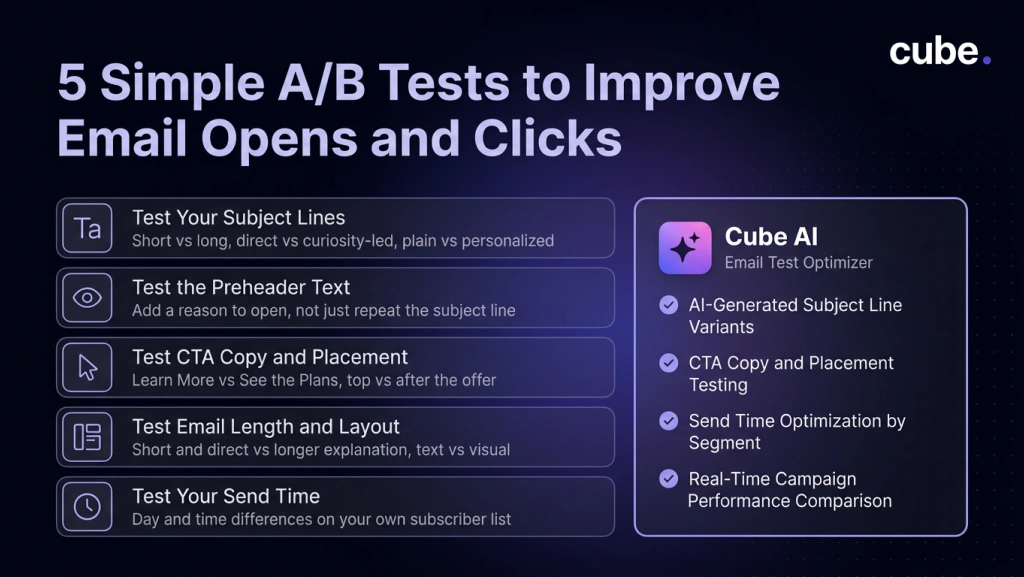
#1 Test Your Subject Lines
If you want to increase email open rate, the subject line is a good place to start.
Try testing one difference at a time. You could compare a short subject line with a longer one, a direct message with a curiosity-led one, or a personalized version with a standard version.
#2 Test the Preheader Text
The preheader is the short text that appears next to or below your subject line in many inboxes.
Instead of repeating the subject line, use it to give the reader one more reason to open the email. You can test a preheader that adds extra information against one that reinforces the main message.
#3 Test CTA Copy and Placement
If people are opening your emails but not clicking, your CTA may be the next thing to test.
For example, compare general copy such as “Learn More” with a more specific action like “See the Plans” or “Get Your Quote.” You can also test whether the CTA works better near the top of the email or after you have explained the offer.
#4 Test Email Length and Layout
Not every audience wants the same type of email.
Some readers may respond better to a short email that gets straight to the point. Others may need more information before they feel ready to click.
Try comparing a shorter version with a longer version that promotes the same offer. You can also test a simple text-focused email against a more visual design.
#5 Test Your Send Time
There is no single best time to send an email to every audience.
Instead of relying only on general recommendations, test different days or times using your own subscriber list. Keep the message and audience similar so you can get a clearer idea of whether timing made a difference.
If one time consistently performs better, you can use it as a starting point for future campaigns.
How to Get Better Results From Email Tests
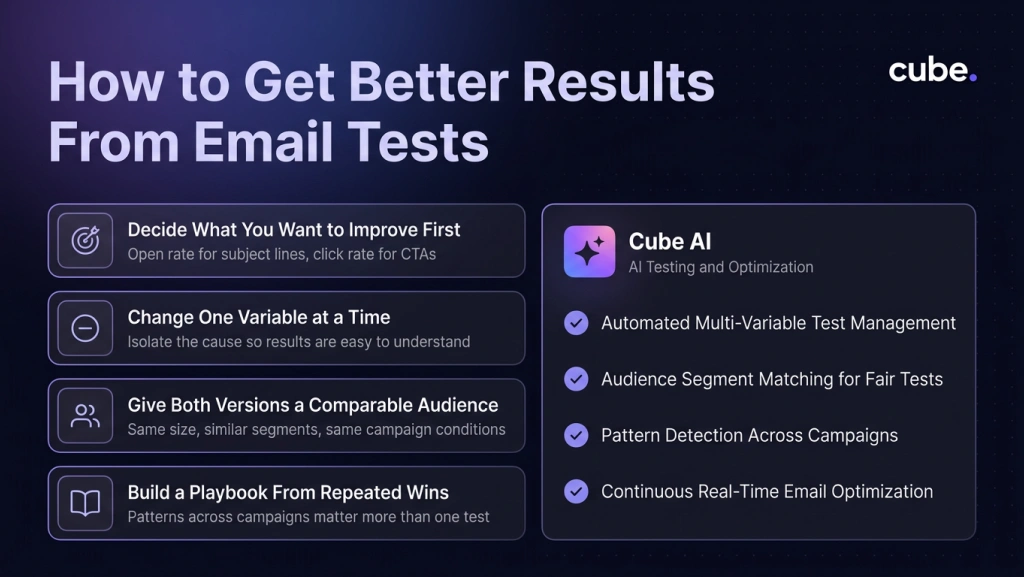
Before running a test, decide what you want to improve.
If you are testing subject lines, focus on open rate. If you are testing CTA copy, look at your email click-through rate.
Change one main variable at a time and give both versions a comparable audience. This makes the results easier to understand.
You should also avoid making big decisions from one small test. Instead, keep a record of what performs well across several campaigns. Over time, those results can become a useful playbook for your email strategy.
How AI Can Help in A/B Testing
Running several tests across multiple campaigns can take time. This is where AI can make the process easier.
AI can help create different subject lines, suggest CTA variations, compare campaign performance, and identify patterns across audience segments. It can also help teams test more ideas without adding the same amount of manual work.
The same principle applies across digital marketing. AI is changing SEO and it works best when it helps teams understand performance, automate repetitive tasks, and make better strategic decisions.
Cube’s AI-powered email marketing platform follows this approach by testing subject lines, optimizing CTAs, segmenting audiences, and improving campaigns in real time.
FAQs
What should I A/B test first in an email?
Start with the subject line if opens are weak, or the CTA if people are opening but not clicking.
How many things should I change in one A/B test?
Change one major variable at a time so you can clearly identify what caused the difference.
Can A/B testing improve email click-through rate?
Yes. Testing CTA copy, placement, content length, and layout can reveal which version encourages more recipients to act.
How often should I run A/B tests?
Run tests regularly, especially when you are trying new campaigns, offers, or audience segments.
Do I need a large email list for A/B testing?
A larger list can give you clearer results, but smaller businesses can still test and look for patterns over time.
Turn Every Email Into a Learning Opportunity
Start with simple changes, track the right metric, and build on patterns that repeat. With the right testing process, every campaign gives you more information about what your audience actually wants.
If you want to make that process easier, book a demo with Cube to see how automated testing, segmentation, and real-time optimization can help your email campaigns improve over time.


