


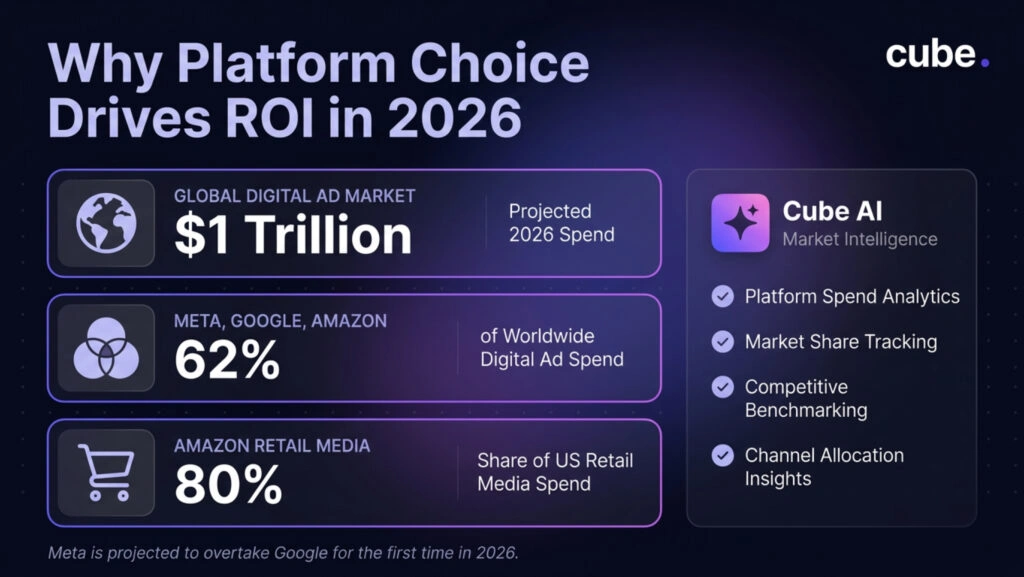
Most ad budgets do not underperform due to weak creative or low spend. They underperform because the money is placed on the wrong platforms. With global ad spending set to top $1 trillion for the first time in 2026, the number of places to advertise has never been larger, and the cost of guessing wrong has never been higher.
Choosing the best advertising platforms for your specific goals is the single biggest lever you have on return. The same product, budget, and creative can earn a strong return on one platform and lose money on another, simply because the audience and intent do not match. This is why disciplined paid marketing starts with platform selection, not ad design.
This blog breaks down the best ad platforms available in 2026, how to choose the right ones for your business, and how to optimize spend for return rather than reach.
Why Platform Choice Drives ROI More Than Budget
Reach is not the same as return. A cheap impression in front of the wrong audience is wasted money, while a more expensive click from someone ready to buy can be the most profitable spend in your account.
Each major platform monetizes a different moment. Search engines capture people who are actively looking to buy. Social feeds reach people who are browsing and open to discovery. Retail platforms reach shoppers at the point of purchase. The best platform is whichever one owns the moment that matters for your offer.
The market reflects this concentration. According to EMARKETER, Meta, Google, and Amazon together are projected to account for roughly 62% of worldwide digital ad spend in 2026, with Meta set to overtake Google for the first time. That dominance exists because these platforms pair massive reach with the first-party data and automation needed to turn spend into measurable return.
The 5 Best Advertising Platforms in 2026

Let’s look at each platform and their performance in detail below.
Google Ads: High Purchase Intent
Google captures demand at the exact moment someone searches. As that intent is so strong, search campaigns consistently post some of the highest return-on-ad-spend benchmarks of any channel. Performance Max extends that reach across search, shopping, YouTube, display, and Gmail using Google’s AI. It is the default starting point for businesses with clear, search-driven demand.
Meta: Facebook and Instagram
Meta operates the largest social advertising ecosystem in the world, reaching well over two billion people across Facebook and Instagram. It excels at visual discovery, broad prospecting, and retargeting, and its AI-driven Advantage+ campaigns have made strong performance easier to reach. For most direct-to-consumer brands, Meta is the workhorse of social media marketing.
Amazon Ads: Bottom-of-Funnel Commerce
Amazon reaches shoppers who already have their wallets out. It now controls close to 80% of US retail media spend, and for e-commerce and product brands, Sponsored Products and Sponsored Brands can capture sales at the precise point of decision. If you sell physical products, Amazon is hard to ignore.
TikTok: Attention and Younger Audiences
TikTok commands more attention per user than any other social platform and reaches a younger, highly engaged audience. Its CPMs are typically lower than Meta’s for awareness, making it more efficient for reach and discovery, especially for impulse-friendly products. It rewards native, creator-style video over polished, traditional ads.
LinkedIn and Niche Platforms
For B2B, LinkedIn delivers precise targeting by job title, company, and industry. Its clicks are the most expensive of the major platforms, but the audience quality often justifies the premium for high-value sales. Pinterest, Reddit, and Snapchat can each win for the right product and the right audience.
How to Choose the Right Ad Platforms
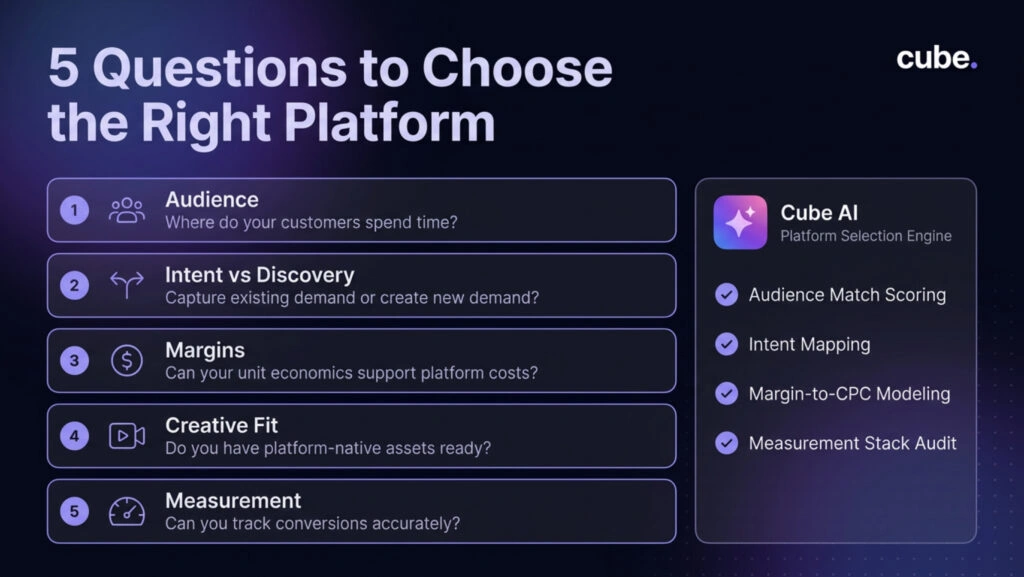
The right mix comes from matching platforms to your business, not from chasing whichever channel is trending. Work through five questions:
- Audience: Where do your customers actually spend time? Match the platform’s core demographic to yours.
- Intent vs. discovery: Are you capturing existing demand (search) or creating it (social)? This decides your primary channel.
- Margins and price point: Can your unit economics support the platform’s typical costs and returns? Higher-ticket items can tolerate a lower ROAS.
- Creative fit: Do you have the assets each platform rewards, such as short-form video for TikTok or strong visuals for Instagram?
- Measurement: Can you track conversions accurately? A platform you cannot measure is a platform you cannot optimize.
Most businesses are better off mastering one or two platforms before expanding. Spreading a small budget across five channels usually yields five sets of inconclusive data rather than one profitable campaign.
Ad Optimization: Turning Spend Into Return
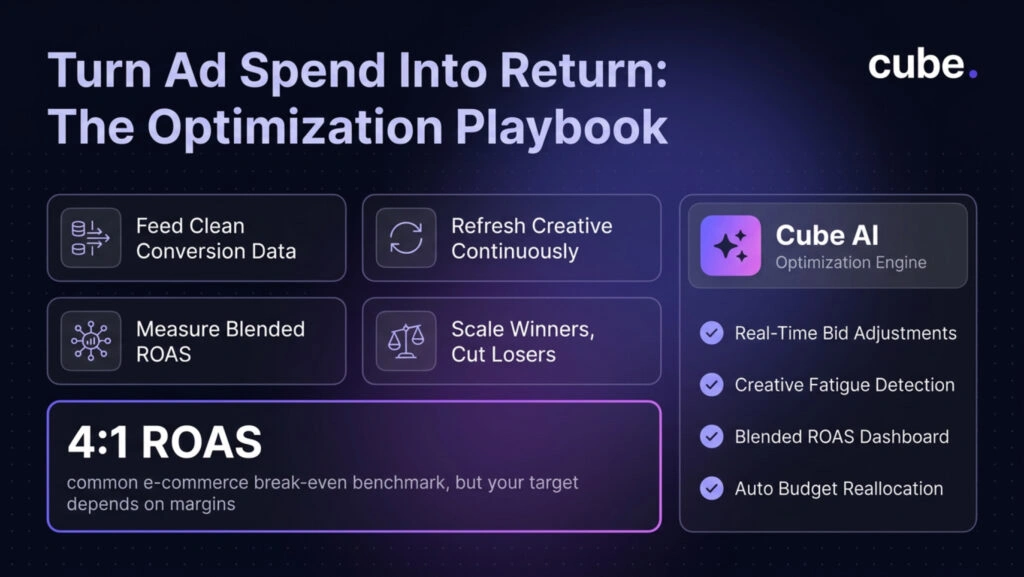
Choosing the platform is the start; ongoing ad optimization is what compounds the return. Start with focused campaigns, test systematically, and scale only what proves profitable while cutting what does not. The shift toward AI-driven, agentic marketing has made this faster, but the fundamentals still decide the outcome.
Feed each platform’s AI clean conversion data so automated bidding can find your best customers. Treat creative as your biggest variable, since refreshing fatigued ads is now one of the most reliable ways to lift performance. Finally, measure blended ROAS across platforms rather than judging each in isolation, because channels often assist one another and social campaigns frequently support conversions that close on search. Paired with strong SEO and email marketing, paid ads become part of a system that grows efficiently.
FAQs
What is the best advertising platform for ROI?
There is no single winner. Google tends to win on purchase intent, Meta on scale and discovery, and Amazon on e-commerce. Test two or three against your own goals.
How many ad platforms should I run at once?
Start with one or two you can fully master, then expand once you have proven a positive, measurable return.
What counts as a good ROAS?
It depends on your margins and industry. A 4:1 return is a common e-commerce benchmark, but your real target is whatever clears your break-even point profitably.
How do I optimize ad spend across platforms?
Track conversions accurately, compare blended ROAS, shift budget toward top performers, and refresh creative regularly to fight ad fatigue.
Maximize Your Ad ROI with Cube
Choosing the right platforms, allocating budget, and optimizing creatives is a full-time job, and doing it well is what separates profitable campaigns from wasted spend.
Cube manages paid advertising across Google, Meta, and other platforms, ensuring every campaign aligns with your goals and maximizes return. If you want every ad dollar working on the right platform, book a demo with Cube to see return-focused advertising in action.


