Table of Contents
- What Is Agentic AI And Why It’s Different From Regular AI
- How Agentic AI Actually Works in Marketing
- How It’s Changing Digital Advertising Right Now
- Agentic AI vs. Traditional Marketing Automation
- Risks and Realities You Should Know
- What This Means for Your Business in 2026
Artificial intelligence is no longer limited to generating content or answering prompts. A new category of systems, known as agentic AI, is starting to change how digital marketing and advertising operate behind the scenes. Unlike traditional AI tools that require constant human direction, agentic AI can pursue goals independently by making decisions, taking action across platforms, learning from outcomes, and continuously improving performance over time.
For marketers, this represents a major shift. Instead of using AI only for isolated tasks like writing copy or summarizing data, businesses are beginning to adopt systems capable of managing larger workflows autonomously. From campaign optimization and audience targeting to reporting and budget allocation, agentic AI is pushing marketing toward a more adaptive and self-operating model.
In this blog, we’ll explore what agentic AI marketing actually means, how it differs from traditional AI systems, where it’s already influencing digital advertising, and why it may redefine the way marketing teams operate in the coming years.
What Is Agentic AI And Why Is It Different?
Agentic AI refers to AI systems designed to pursue objectives rather than simply respond to prompts. Instead of generating a single output and stopping there, these systems can break a goal into multiple steps, determine what actions are needed, execute tasks across connected tools, and adjust based on the results they observe.
Traditional AI models are typically limited to prediction, classification, or content generation. Agentic AI extends beyond those functions by introducing autonomous decision-making and execution. In a marketing environment, this could mean identifying a drop in campaign performance, testing alternative targeting, reallocating spend, and tracking the outcome automatically.
The key distinction is that agentic AI operates more like a continuous workflow manager than a one-time assistant. Human oversight still plays an important role, particularly for strategic direction, approvals, and risk management, but much of the operational execution can happen dynamically and at scale.
How Agentic AI Actually Works in Marketing
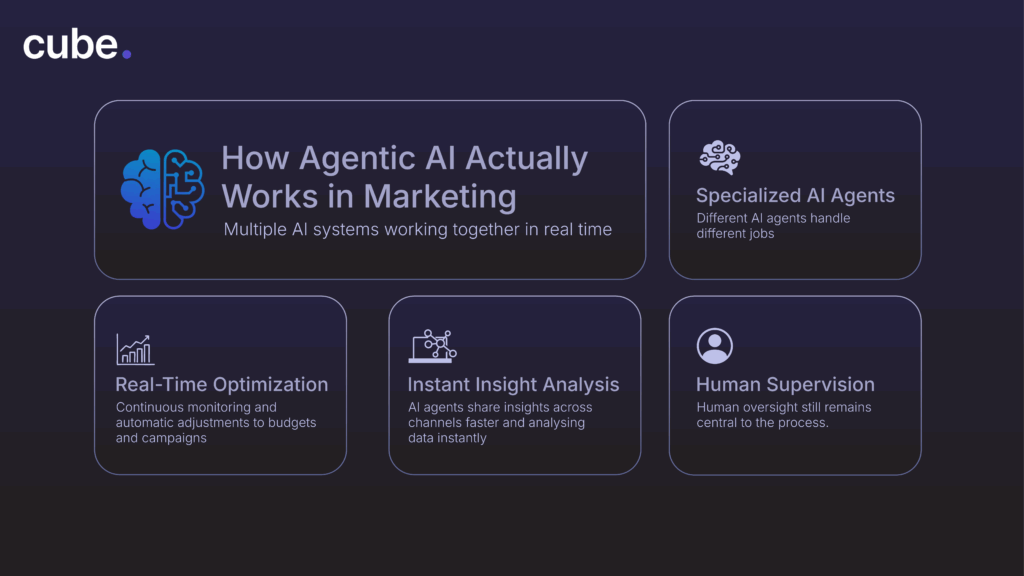
In a marketing environment, agentic AI often operates through specialized systems or agents designed for specific functions. One may monitor paid advertising performance, another may identify SEO and content opportunities, while others handle tasks like email optimization, customer segmentation, or review management. Together, these systems can share signals across platforms and help marketing teams respond faster to changes in performance.
Real-time data processing is one of the biggest differences between agentic workflows and traditional marketing operations. Instead of waiting for weekly reporting cycles, AI systems can continuously analyze campaign data, detect performance shifts, and recommend or execute optimizations as conditions change. For example, an AI-driven advertising workflow might identify rising acquisition costs, compare audience performance trends, and automatically shift budget allocation toward stronger-performing campaigns. Research shows AI-driven marketing automation can cut customer acquisition costs by up to 50% when applied at scale.
Human oversight still remains central to the process. Marketing teams define strategy, goals, brand guidelines, and approval thresholds, while AI systems handle large-scale execution and optimization tasks that would be difficult to manage manually across multiple channels.
What an Agentic AI Marketing Workflow Looks Like
Picture a Tuesday morning for a multi-location restaurant group. Overnight, one location’s Google review score drops after a cluster of negative feedback. An AI-driven review management system detects the shift, drafts suggested responses, and sends them to a marketing manager for approval before publishing. At the same time, an advertising optimization workflow identifies that the lunch promotion for that location is underperforming and recommends shifting part of the daily budget toward a higher-converting campaign.
Instead of waiting for someone to manually check dashboards or compile reports, the system continuously monitors performance signals across channels and surfaces actions in real time. The marketing team still sets the strategy and approves important decisions, but much of the operational monitoring and optimization happens automatically. That combination of automation, decision support, and cross-platform coordination is what makes agentic AI workflows fundamentally different from traditional marketing automation.
How It’s Changing Digital Advertising Right Now
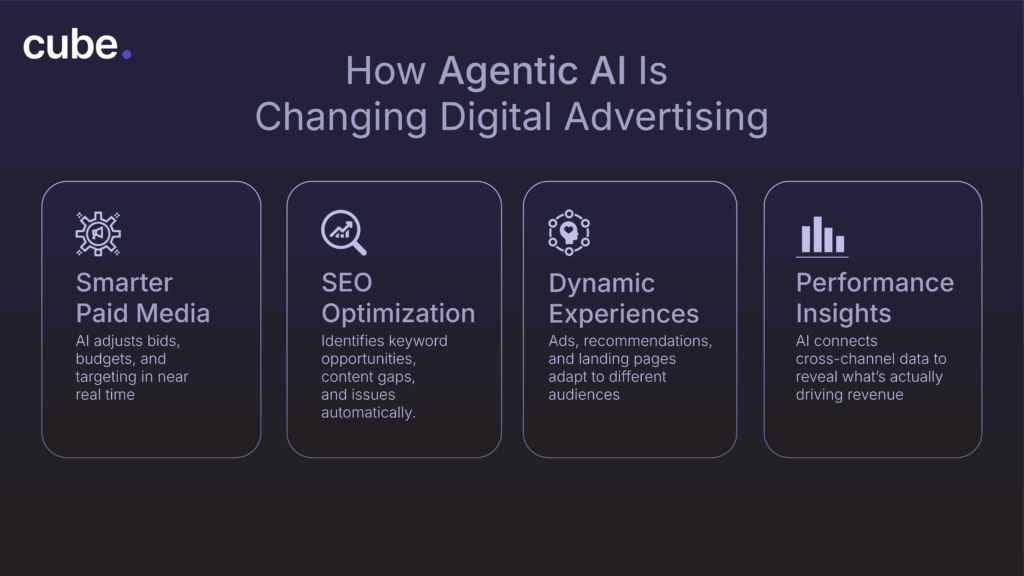
Agentic AI is already beginning to reshape several core areas of digital advertising:
Paid Media: AI-driven systems can adjust bids, budgets, and audience targeting in near real time, helping campaigns respond faster to performance changes than traditional manual optimization workflows.
SEO: AI-powered workflows continuously identify keyword opportunities, content gaps, technical issues, and optimization priorities based on projected search and traffic impact.
Personalization: Ad creative, product recommendations, and landing page experiences can adapt dynamically to different audience segments, improving relevance and reducing the time required for manual testing and iteration.
Attribution and Reporting: AI systems can consolidate cross-channel performance data, surface patterns faster, and help marketers understand which campaigns and touchpoints are contributing most to revenue.
Industry analysts expect AI-augmented marketing workflows to become standard across enterprise teams over the next several years as businesses move toward faster, more automated campaign execution.
What This Means for Your Business in 2026
For SMBs and multi-location brands, agentic AI has the potential to reduce many of the operational advantages historically held by companies with larger marketing teams and bigger budgets. Businesses that once relied heavily on agencies or large in-house teams can now automate parts of campaign monitoring, optimization, reporting, and customer engagement at a much larger scale than before.
Several trends are shaping how agentic AI will influence marketing in 2026, including deeper integration with first-party data, stronger coordination across channels, and a growing shift away from manual campaign management toward AI-assisted execution. As these systems improve, businesses adopting them earlier may gain meaningful efficiency and response-time advantages over competitors still relying entirely on manual workflows.
Three questions worth asking about your current marketing operations:
- How much time does your team spend on repetitive monitoring and reporting?
- How quickly can you respond when campaign performance starts to decline?
- How consistent is your execution across channels, campaigns, and locations?
If those areas are becoming difficult to manage at scale, agentic AI may play an increasingly valuable role in your marketing operations.
The broader shift happening right now is from isolated marketing tools toward connected systems that can assist with ongoing execution and optimization.
How Cube Puts Agentic AI Marketing Into Practice
Cube specializes in AI agents executing across SEO, paid ads, social media, email, and review management, all coordinated under one system with human strategists keeping everything tied to your business goals.
You’re not stitching together five separate tools and hoping the data connects. When one agent detects a dip in ad performance or a shift in review sentiment, it acts and flags what needs human sign-off.
Book a demo with Cube and see what agentic AI marketing looks like!