Table of Contents
- What Is Generative Engine Optimization (GEO)?
- GEO vs. Traditional SEO: What Actually Changed
- How AI Search Engines Decide What to Surface
- How to Optimize Your Content for AI Search in 2026
- AI Search Optimization Tools Worth Using
- Common GEO Mistakes That Kill Your AI Visibility
Ranking on Google and appearing in AI-generated answers are two different games. A page can sit comfortably on the first page of Google results and never get cited once by ChatGPT, Perplexity, or Google’s AI Overviews. That gap is widening, and businesses relying on traditional SEO alone are leaving real visibility behind.
This blog covers what Generative Engine Optimization actually is, how AI search engines decide what to surface, and what you need to do to show up in 2026.
What Is Generative Engine Optimization (GEO)?
Generative Engine Optimization is the practice of optimizing your content to appear in AI-generated answers, not just traditional blue-link results. Where classic SEO targets a position on a results page, GEO targets inclusion in synthesized responses that AI engines pull together from multiple sources at once.
The platforms where GEO matters most right now: ChatGPT, Perplexity AI, Google AI Overviews, and Gemini. Each pulls from indexed web content, processes it with large language models, and produces a single consolidated answer. Your content either gets woven into that answer or gets ignored entirely.
AI engines don’t rank pages the way Google does. They cite them. That shift makes brand mentions and citations the new ranking signals. A 2024 study from Princeton, Georgia Tech, and IIT Delhi found that adding statistics, quotes, and authoritative references increased AI citation rates by up to 40%. Being referenced by trusted third-party sources signals to AI models that your brand is a credible entity worth including in a response.
GEO vs. Traditional SEO: What Actually Changed
Traditional SEO is built around keywords. You find what people type into a search bar, optimize pages around those terms, and earn backlinks to signal authority. GEO operates on a different layer.
AI engines think in entities, not keywords. They understand that “best Italian restaurant in Austin” and “top pasta spots near downtown Austin” point at the same concept. Optimizing for entities means making sure your brand, products, and topics are clearly defined and consistently represented across the web, not just on your own domain.
Trust signals have shifted, too. Backlinks still matter for traditional SEO, but AI models weigh brand authority differently. They look at how often your brand gets mentioned in credible publications, forums, review platforms, and knowledge sources. Zero-click AI citations are also replacing click-through traffic on informational queries, which means you need visibility inside the answer itself, not just a spot on the page below it.
What carries over from SEO: technical site health, content quality, E-E-A-T signals, and structured data. These aren’t obsolete. They’re the foundation on which GEO builds.
How AI Search Engines Decide What to Surface
Most AI search engines use retrieval-augmented generation (RAG). The engine retrieves relevant content from indexed sources, then uses a language model to synthesize that content into a response. Your page needs to be both retrievable and extractable to make the cut.
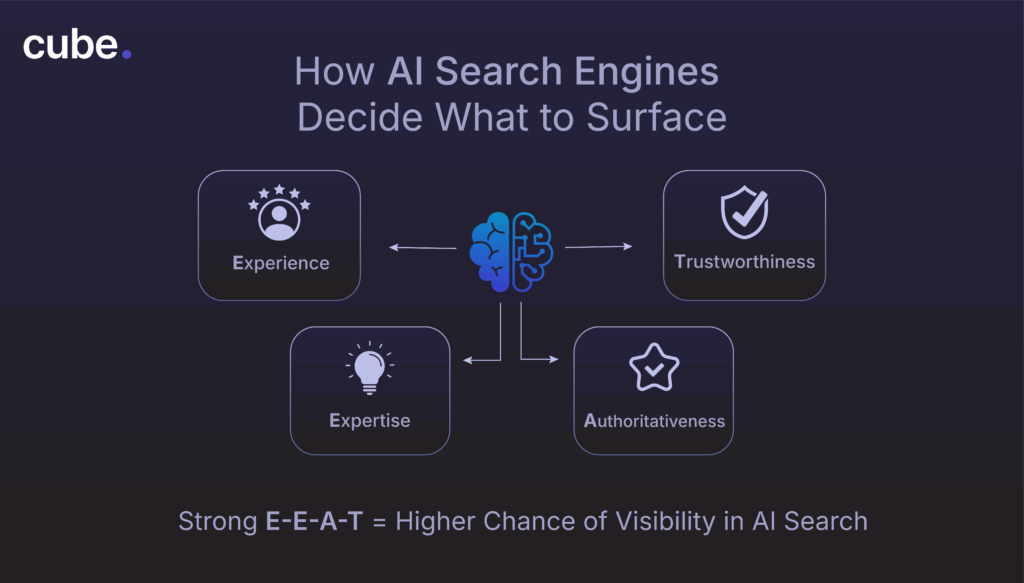
E-E-A-T signals, Experience, Expertise, Authoritativeness, and Trustworthiness, play a direct role in how AI models assess credibility. Google’s own documentation confirms these signals influence content evaluation, and AI engines trained on web data carry similar preferences toward authoritative sources.
Content freshness matters more than most people assume. Stale pages with outdated statistics get deprioritized when AI engines look for reliable answers to current questions. Regular updates signal that your site is an active, maintained source worth citing.
Structured, scannable content also gets extracted more reliably. AI engines parse headers, bullet points, and definition-style formatting far more efficiently than dense prose. If your content is hard for a human to skim, it’s hard for an AI to extract.
How to Optimize Your Content for AI Search in 2026
Let’s look at the step-by-step process:
Step 1: Make Your Content Crawlable and Structured
Start by confirming your robots.txt file isn’t accidentally blocking AI crawlers. Several major AI platforms use their own crawl bots, and a misconfigured robots.txt can exclude your site from AI indexing entirely, with no warning.
Schema markup is one of the highest-leverage technical moves you can make for GEO. FAQ schema, HowTo schema, Article schema, and Organization schema all improve AI extractability by giving engines explicit, machine-readable signals about what your content contains. Pair schema with clean header hierarchies, bullet-formatted lists, and definition-style answers to make your content as parseable as possible.
Step 2: Write for Conversational and Sub-Query Intent
AI engines don’t process a query as a single question. They break complex searches into sub-questions and pull answers to each component from different sources. A query like “how do I rank in AI search” gets decomposed into questions about what AI search is, what factors influence it, and what steps to take.
FAQ-style sections built around natural language questions match this behavior directly. Long-tail, question-based phrases that mirror how people actually talk to AI tools, like “what does GEO mean for small businesses” or “how does Perplexity decide what to cite,” give AI engines clean, quotable answers to pull into responses.
Step 3: Build Entity Authority and Brand Signals
Getting your brand mentioned on third-party sites that AI models trust is one of the most effective GEO moves available. That means earning coverage in industry publications, getting listed in relevant directories, and generating reviews on platforms like Google, Yelp, and Trustpilot. For local and multi-location brands, consistent NAP data (name, address, phone number) and an accurate Google Business Profile significantly strengthen your entity signals.
User-generated content, including customer reviews and mentions on community forums, also serves as a credibility signal. AI engines treat authentic third-party references as evidence that your brand delivers on what it claims. Cube’s review monitoring tools help SMBs track and respond to reviews across platforms, keeping those signals fresh and consistent without requiring manual oversight.
Step 4: Demonstrate E-E-A-T Through Content Depth
Author credentials and bylines matter. Pages that attribute content to named experts with verifiable backgrounds get treated as more credible sources by AI models. Add author bios, link to professional profiles, and make expertise visible on the page.
Data-backed content gets cited more often than opinion-based content. Include statistics with sourced links, reference original research, and build content around verified claims. AI engines distinguish between recycled summaries and original analysis, and they favor the latter when generating answers worth citing.
Each of these steps compounds over time. The brands that treat GEO as an ongoing system, not a one-time checklist, are the ones AI engines learn to trust, cite, and recommend. Start with the step that closes your biggest gap, and build from there.
AI Search Optimization Tools Worth Using
As AI search evolves, brands need visibility into how they appear across platforms like ChatGPT, Google AI Overviews, Gemini, and Perplexity. Tracking mentions, citations, and response positioning is becoming just as important as traditional rankings.
Cite AI is built specifically for AI search visibility monitoring. The platform helps brands track how often they appear in AI-generated answers, where they rank within those responses, and which sources AI systems cite most frequently.
Instead of manually checking prompts across multiple AI platforms, Cite AI centralizes visibility tracking, citation monitoring, competitor comparisons, and prompt-level analytics in one dashboard. This makes it easier for marketing teams to identify visibility gaps, improve GEO performance, and monitor how AI perception changes over time.
For businesses managing multiple brands, products, or locations, automated AI visibility monitoring helps maintain a consistent brand presence without relying on manual checks across different AI engines.
Common GEO Mistakes That Kill Your AI Visibility
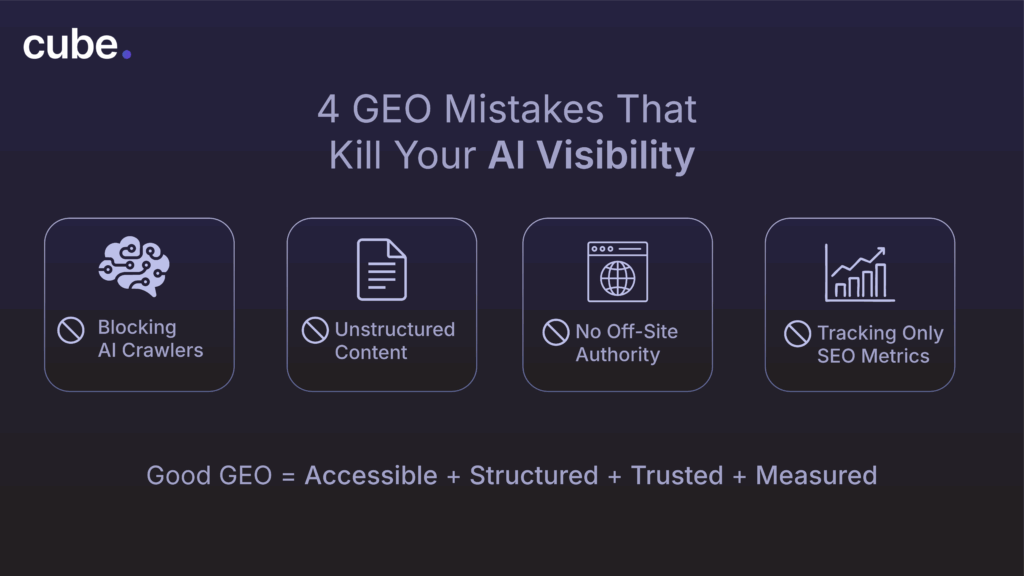
Most GEO failures come down to a short list of avoidable errors.
- Blocking AI Crawlers in robots.txt: A disallow rule aimed at one bot can inadvertently exclude multiple AI crawlers. Audit your robots.txt regularly and verify which crawlers have access.
- Publishing Thin, Unstructured Content: Pages with no clear entity signals, no headers, and no structured data give AI engines nothing to extract. Thin content gets passed over regardless of how well it ranks on Google.
- Ignoring Off-site Authority Building: If your brand only exists on your own domain, AI engines have limited external signals to validate your credibility. Third-party mentions, reviews, and citations are non-negotiable for GEO.
- Measuring GEO with Traditional SEO Metrics Only: Organic click-through rate and keyword rankings don’t capture AI citation frequency or brand mention volume. You need GEO-specific tracking to know whether your efforts are working.
GEO isn’t a one-time optimization project. It runs in parallel with your SEO efforts, not instead of them. The businesses already building strong fundamentals, structured content, authoritative brand signals, and consistent off-site presence are better positioned for AI search than most. The overlap between solid SEO and GEO readiness is real, and for SMBs who want that visibility without managing it manually, the answer is automation backed by human strategy.
Grow Your Brand With Cube’s AI Marketing Platform
GEO isn’t a one-time project; it runs alongside your SEO efforts and compounds the longer you stay consistent. Structured content, strong brand signals, and active review management need to work together and keep working without your team manually chasing every update.
Cube brings that all together on one platform: AI agents handle SEO, paid ads, reviews, and content optimization while human strategists keep everything aligned with your business goals.
If you’re ready to show up in AI search results and not just Google, book a demo with Cube and see what automated GEO execution looks like in practice.