


Search has been split into two. Google still processes billions of queries every day. Still, a growing share of those queries is now answered by ChatGPT, Perplexity, Google AI Overviews, and Gemini before a user clicks a single link. ChatGPT alone serves over 900 million users weekly.
Google AI Overviews appear in most informational searches. These platforms do not show a list of ten blue links. They synthesize one answer from multiple sources and present it directly.
For businesses, this creates a visibility problem that traditional SEO alone cannot solve. A page can rank on Google’s first page and still never get cited in an AI-generated response. Research shows that only about 12% of ChatGPT citations match URLs ranking on Google’s first page. Strong Google rankings no longer guarantee visibility where a growing number of users are actually looking for answers.
This blog covers what AI SEO optimization requires in 2026, how to structure content so AI engines can extract and cite it, and what separates brands that show up in AI answers from those that get passed over.
How AI Search Engines Decide What to Cite
AI search platforms operate on a framework called retrieval-augmented generation (RAG). The engine retrieves relevant content from indexed web sources, then uses a large language model to synthesize that content into a conversational response. Your page needs to be both retrievable and extractable to get included.
This is where AI SEO optimization diverges from traditional keyword-based SEO. AI engines evaluate whether your content clearly answers a specific question, whether the source is credible, and whether the information is structured in a way that can be pulled into a response without losing meaning. They think in entities and topics, not exact-match keywords.
E-E-A-T signals play a direct role in source selection. Named authors with verifiable expertise, original research, cited statistics, and content published on authoritative domains all increase the likelihood of being cited. Generative Engine Optimization (GEO) builds on these principles, targeting inclusion in AI-generated answers rather than just a position on a results page.
Content freshness matters more than most teams realize. AI engines show a documented preference for recently updated sources. Studies indicate that content updated within the last 30 days earns significantly more AI citations than older material. Stale statistics and outdated examples reduce your chances of being surfaced.
How to Optimize Content for AI Search in 2026
The following steps cover the structural, technical, and authority-building signals that determine whether AI engines cite your content or skip it.
Confirm AI Crawlers Can Access Your Pages
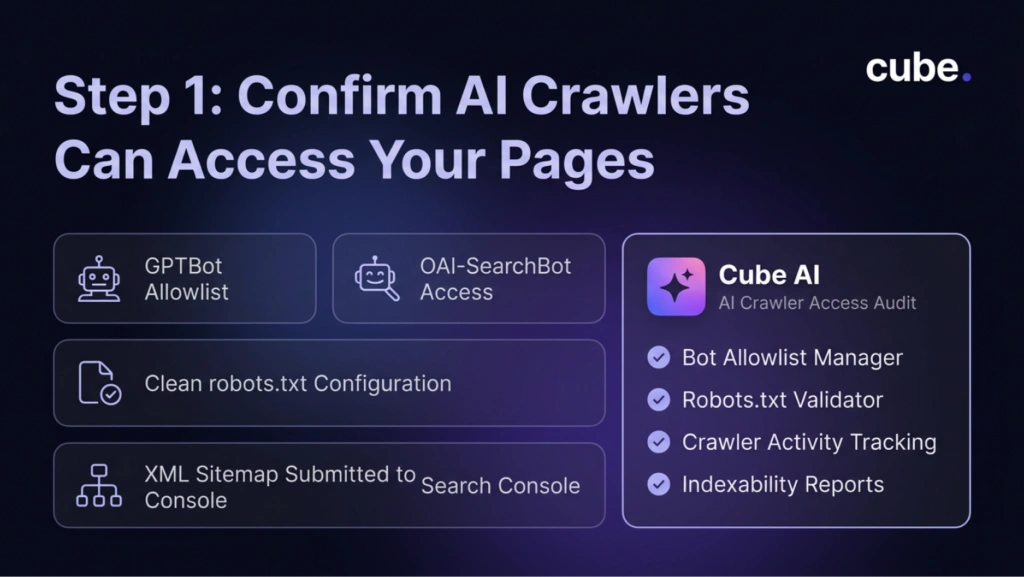
Before any content optimization matters, AI crawlers need access to your site. OpenAI uses two separate bots: GPTBot for model training and OAI-SearchBot for ChatGPT’s live search answers. Blocking OAI-SearchBot in your robots.txt means your content will not appear in ChatGPT responses, regardless of quality.
Audit your robots.txt to confirm major AI crawlers are not accidentally blocked. Pair that with a clean XML sitemap submitted through Google Search Console, and make sure your technical SEO foundation supports both traditional and AI-powered crawling.
Structure Content for AI Extraction
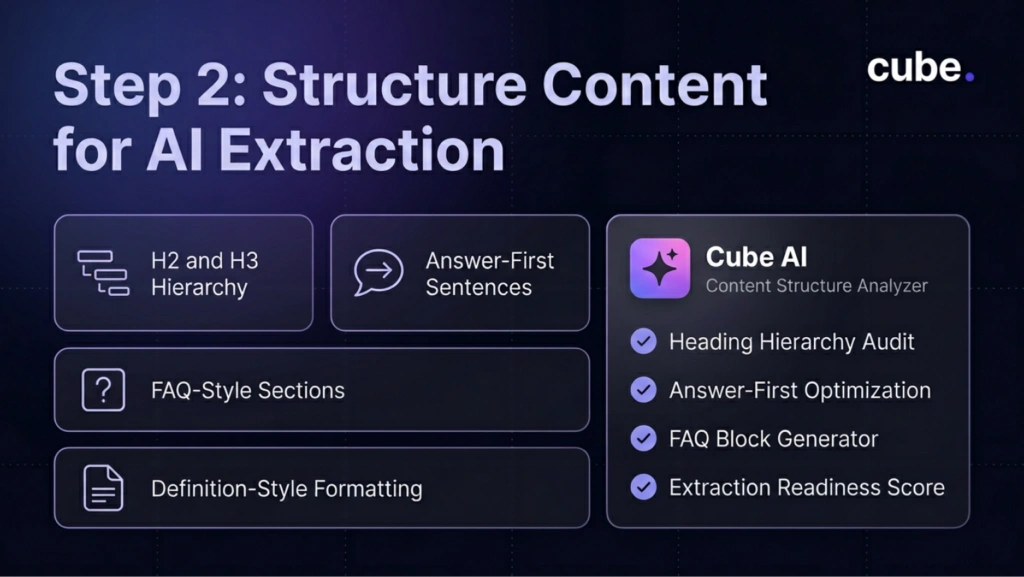
AI engines parse headers, lists, and definition-style formatting far more efficiently than dense prose. Pages with clear H2 and H3 structures are significantly more likely to be cited. Lead each section with one to two sentences that directly answer the heading, then expand with supporting detail.
FAQ-style sections work particularly well. AI engines break complex queries into sub-questions and pull answers to each component from different sources. Writing content around the way people actually talk to AI tools gives engines clean, quotable answers to include in their responses.
Build Entity Authority Beyond Your Domain
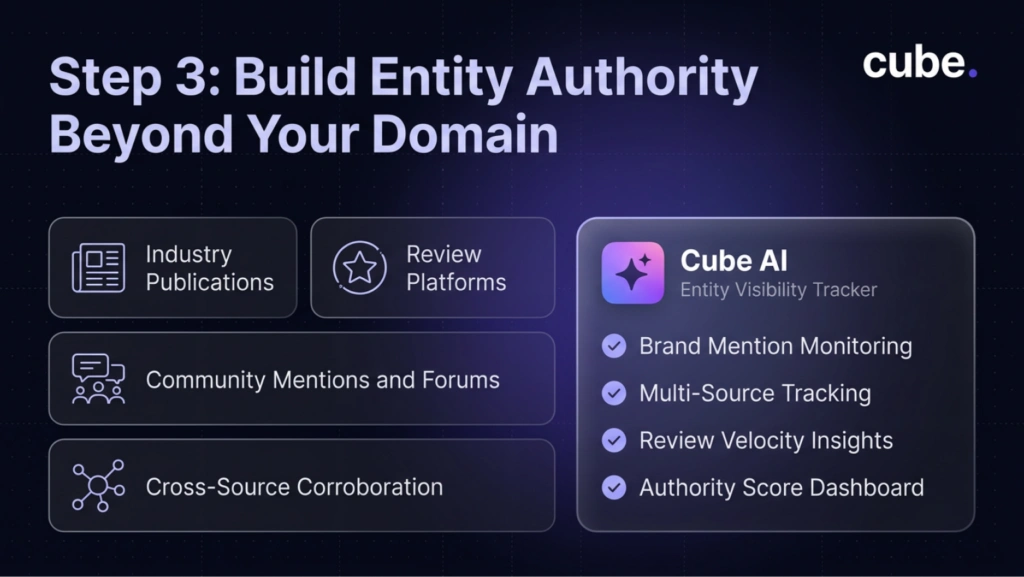
Getting your brand mentioned on third-party sites that AI models trust is one of the most effective ways to improve AI visibility. Earn coverage in industry publications, generate reviews on platforms like Google and Trustpilot, and participate in relevant community discussions.
AI engines cross-reference claims across sources. If your content is corroborated by mentions on review platforms, news sites, or industry forums, your citation probability increases. This differs from traditional link building because the goal is a visible presence across the sources AI models already reference, not just backlink acquisition. A strong SEO foundation compounds this effect across both traditional and AI search.
Implement Schema Markup for Extractability
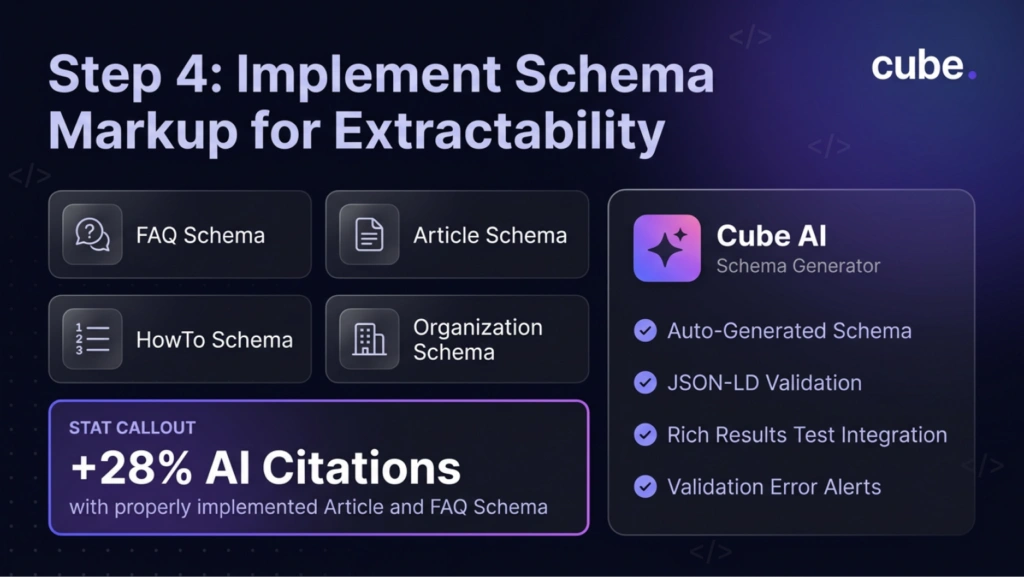
Schema markup gives AI engines explicit, machine-readable signals about what your content contains. FAQ schema, Article schema, HowTo schema, and Organization schema all improve the reliability with which AI platforms identify and extract information from your pages.
Benchmark data from Search Engine Land found that proper Article and FAQ schema increased AI citations by 28%. For brands already investing in AI-powered marketing strategies, adding structured data is among the most impactful technical steps.
Strengthen Credibility Through Content Depth
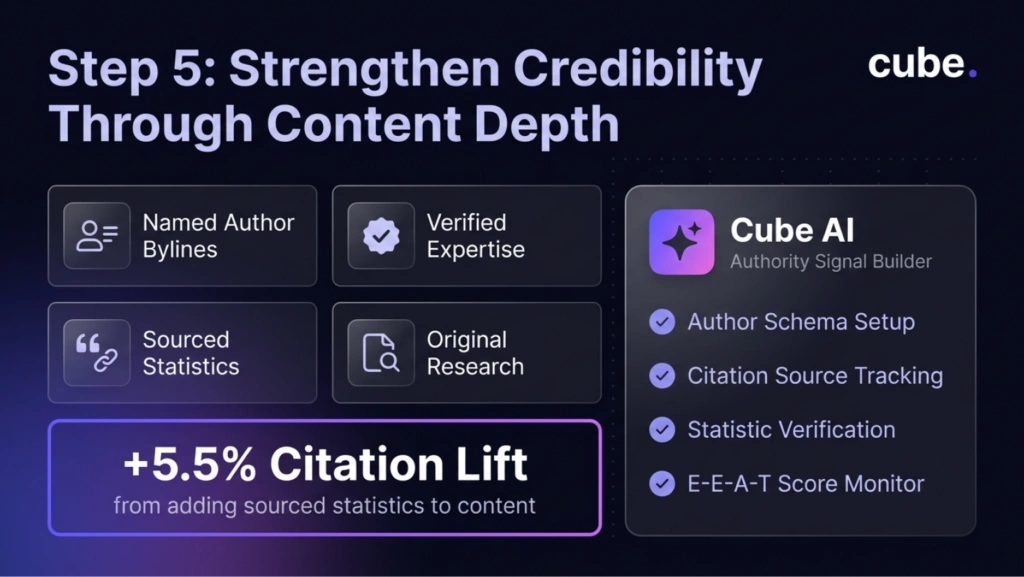
Author credentials and bylines matter. Pages attributed to named experts with verifiable backgrounds are treated as more credible by AI models. Include statistics with sourced links, reference original research, and build content around verified claims. Princeton research found that adding specific statistics boosted AI citation performance by over 5.5% compared to single-tactic optimization alone.
FAQs
Is optimizing for AI search different from traditional SEO?
Yes. Traditional SEO targets rankings on results pages, while AI SEO optimization targets citations and inclusion in AI-generated answers. The tactics overlap, but AI engines prioritize structured, extractable, entity-rich content.
Do I need separate content for ChatGPT and Google?
No. One well-structured piece can perform on both. Use answer-first formatting, clear headings, schema markup, and strong authority signals to serve traditional and AI search simultaneously.
How do I track whether my content appears in AI results?
AI visibility tracking is still maturing, but specialized tools can monitor brand mentions across ChatGPT, Perplexity, and Google AI Overviews. Start by monitoring referral traffic from chatgpt.com and perplexity.ai in your analytics.
Does schema markup help with AI citations?
Yes. FAQ and Article schema make content directly extractable by AI systems. Benchmark data shows that a properly implemented schema can increase AI citations by up to 28%.
Show Up in AI Search Results with Cube
Ranking on Google and appearing in AI-generated answers require parallel optimization strategies working together. Structured content, entity signals, technical health, and off-site authority all need consistent execution.
Cube brings SEO, paid ads, email, social, and review management together on one platform, with AI agents handling execution and human strategists keeping everything aligned with your business goals. If you want your brand to show up where your audience searches, book a demo with Cube to see what AI-optimized marketing looks like in practice.


