Email marketing remains one of the highest-ROI channels for businesses. But the way performance gets measured has changed significantly. Privacy updates from Apple, stricter deliverability standards from Google, and the growing role of AI in campaign execution have all shifted what “good performance” actually looks like.
Most teams are still measuring success the same way they did in 2023. Open rates get treated as the headline metric. Click-through rates get glanced at in monthly reports. Revenue attribution stays vague enough that no one questions it. If your email marketing benchmarks haven’t been updated, you are optimizing for signals that no longer reflect real engagement.
This blog breaks down the email marketing KPIs that matter in 2026, what the latest Klaviyo benchmarks show, and how to use these numbers to improve your email program.
Why Traditional Email Benchmarks Are Losing Relevance
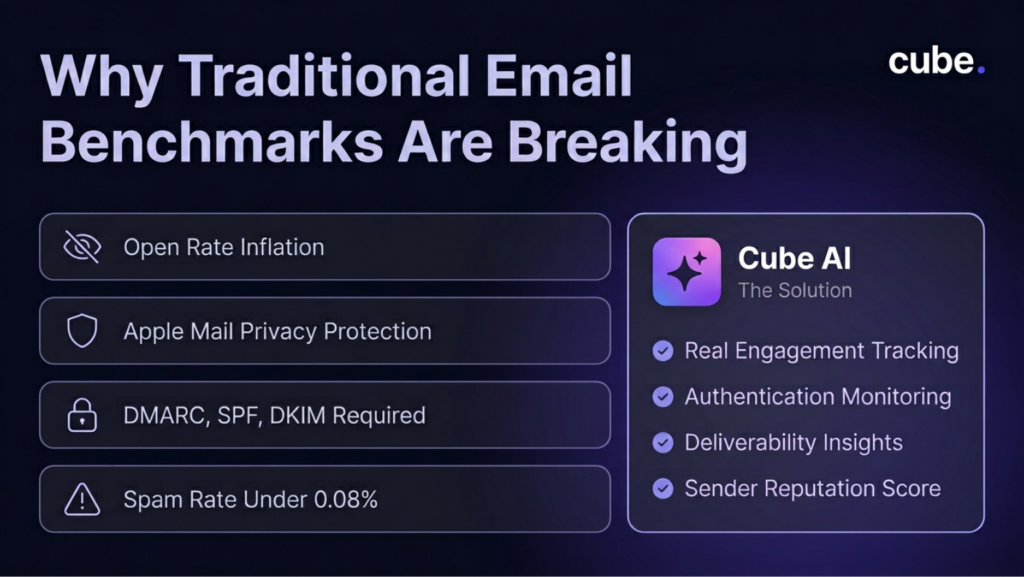
Open rates used to be the first metric every marketer checked. That is no longer a reliable practice. Apple’s Mail Privacy Protection preloads tracking pixels regardless of whether the recipient actually reads the email. This inflates open rates and makes it difficult to distinguish genuine engagement from automated activity.
Average open rates across industries now range from 35% to 42% for campaigns, but those numbers are misleading. A brand could show a 40% open rate while only a fraction of those recipients actually engaged.
Google and Yahoo also tightened sender requirements in 2024, making DMARC, DKIM, and SPF authentication mandatory for bulk senders. Brands that haven’t kept up see emails land in spam, skewing every downstream metric. Before optimizing any email marketing KPIs, deliverability needs to be solid: delivery rate above 98%, bounce rates below 0.5%, and spam complaint rates under 0.08%.
The Email Marketing Benchmarks That Actually Matter in 2026
Here are the core metrics worth tracking this year, along with current industry benchmarks.
Click Rate
Click rate measures the percentage of recipients who clicked a link out of everyone who received the email. It requires a deliberate action, making it a far more reliable indicator of content relevance than open rate.
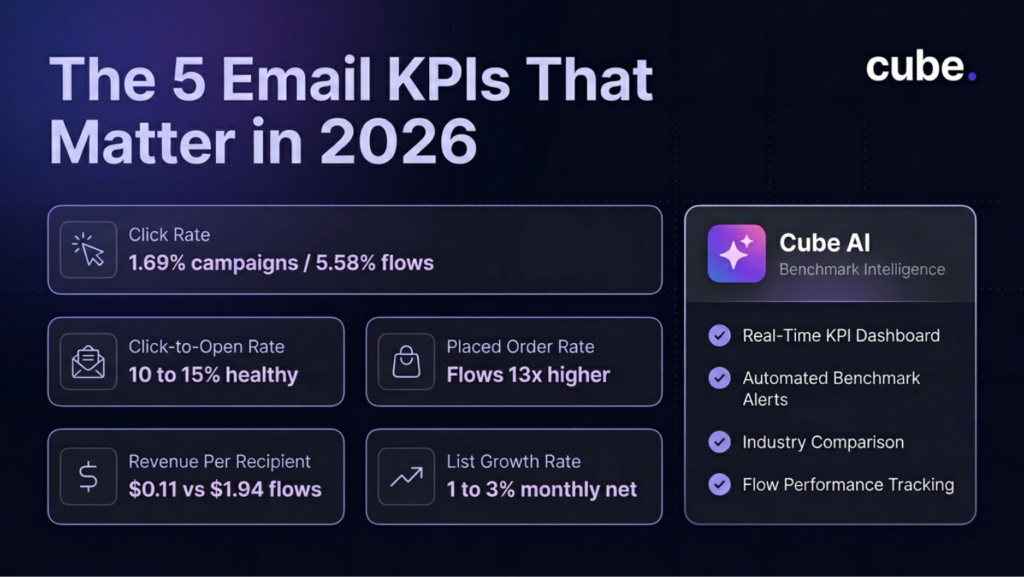
According to Klaviyo’s 2026 benchmark report, based on over 183,000 brands, the average campaign click rate sits around 1.69%. Automated flows perform significantly better at 5.58%. Top performers are hitting click rates above 10% on their flows. If your campaign click rates are consistently below 1.5%, it is worth revisiting your email marketing segmentation and content strategy.
Click-to-Open Rate (CTOR)
CTOR isolates the performance of your email content by measuring clicks only among people who opened the email. It removes the noise from deliverability and subject line performance, giving you a cleaner read on whether the email body is working.
A healthy CTOR ranges from 10% to 15%. Anything below 8% suggests the content, design, or call-to-action is underperforming relative to the interest your subject line generated.
Revenue Per Recipient (RPR)
RPR directly links email performance to revenue. It divides total attributed revenue by the number of recipients, giving you a per-send value that accounts for engagement and conversion quality.
For ecommerce brands on Klaviyo, average campaign RPR sits around $0.11, while flow-based emails average $1.94 per recipient. Flow-based emails see RPR roughly 18 times higher on average, though this varies widely by brand, from 2x to 75x depending on list size, vertical, and flow maturity. Either way, it makes a strong case for investing in automated sequences.
Placed Order Rate (Conversion Rate)
This measures the percentage of recipients who completed a purchase after receiving an email. The average placed-order rate across industries is approximately 0.08% for campaigns. Flows outperform campaigns by roughly 13 times on this metric, reinforcing the importance of behavioral triggers and timely automation over batch-and-blast sends.
List Growth Rate
A metric that often gets overlooked is list growth. Your email list decays naturally as subscribers disengage, unsubscribe, or change addresses. Healthy programs maintain a net list growth rate of 1% to 3% monthly after accounting for churn, with top performers reaching higher. If your list is flat or shrinking, acquisition channels need attention before campaign optimization will make a difference.
Flows vs. Campaigns: Where the Real Revenue Lives
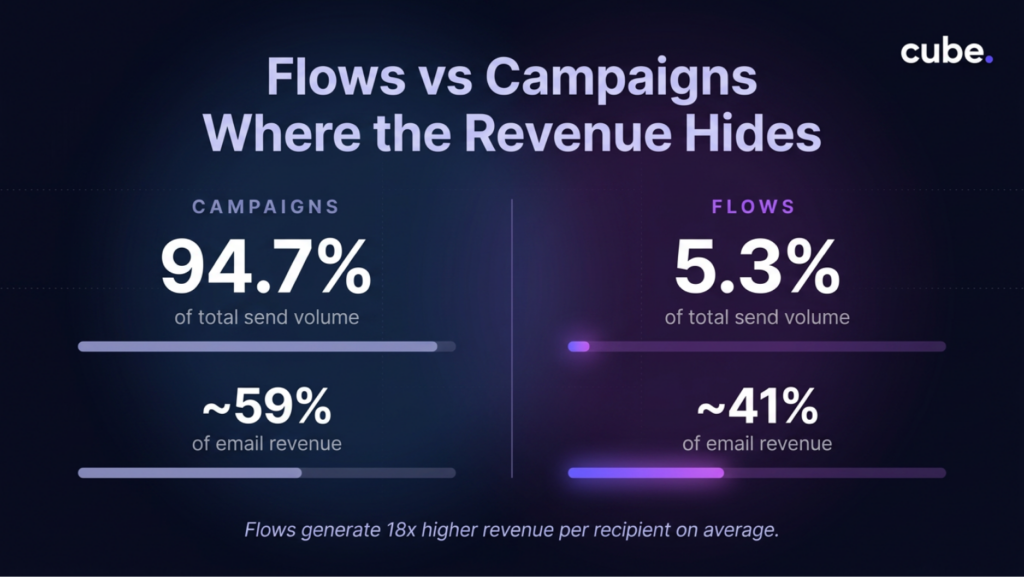
One of the most important findings from the 2026 Klaviyo benchmarks is the performance gap between automated flows and manual campaigns. Campaigns account for about 94.7% of total send volume, but a smaller share of revenue efficiency. Flows, making up just 5.3% of sends, generate nearly 41% of total email revenue.
Flows are triggered by specific subscriber behaviors, such as browsing a product, abandoning a cart, or making a first purchase. The timing and relevance are inherently higher than a scheduled campaign sent to a broad list. Mature email programs typically split revenue 50/50 or even 60/40 in favor of flows. Building core flows such as welcome series, cart abandonment, and post-purchase sequences is the fastest way to improve performance.
How AI Is Shifting Email Marketing KPIs
AI is no longer a future consideration for email marketing. Over 80% of marketers report using AI for content creation, including email copy. But the bigger impact is on segmentation, send-time optimization, and predictive targeting.
Klaviyo’s data shows that AI-powered product recommendations lift email click rates to an average of 3.75%, with top performers reaching 8.79%. That highlights how machine-learning-driven personalization directly improves the benchmarks that matter.
AI also accelerates production timelines. Litmus reports that 78% of teams now deploy emails within three days, compared to 2024 when 62% of teams needed two weeks or more. For businesses exploring how AI is reshaping marketing operations, email is one of the clearest use cases. Teams integrating AI into their paid advertising and email workflows are seeing compounding benefits, where audience signals from one channel inform targeting in the other.
FAQs
What is a good email open rate in 2026?
Average open rates range from 35% to 42% for campaigns and 40% to 60% for flows, but Apple’s Mail Privacy Protection inflates these numbers, making click rate and RPR more reliable indicators.
How often should I clean my email list?
Clean your list every 3 to 6 months by suppressing or removing subscribers who have not opened or clicked in the past 120 days to protect your sender reputation and deliverability.
What is the difference between click rate and click-to-open rate?
Click rate measures clicks as a percentage of all delivered emails, while click-to-open rate measures clicks only among recipients who opened the email, giving a more accurate read on content performance.
How much revenue should email generate for an e-commerce brand?
Many mature ecommerce brands report generating 25% to 40% of total revenue from email and SMS combined, though this figure varies by vertical, attribution model, and how aggressively a brand invests in automation. Top performers push that number even higher through well-built flows.
Are Klaviyo benchmarks relevant for non-ecommerce businesses?
Klaviyo benchmarks are based primarily on ecommerce data from over 183,000 brands, making them most applicable to B2C and DTC businesses. B2B companies should use them directionally while building internal benchmarks from their own historical data.
Start Tracking the Benchmarks That Drive Revenue with Cube
Email marketing benchmarks are only useful if they lead to action. Knowing where you stand relative to industry averages is the starting point, but closing the gap requires consistent execution across segmentation, automation, content, and deliverability.
Cube brings email marketing, SEO, paid ads, social, and review management together on one platform. AI agents handle campaign optimization, audience segmentation, and performance tracking while human strategists keep everything aligned with your goals.
If your email benchmarks are falling short, book a demo with Cube and see what AI-powered email execution looks like in practice.